I feel bad that I never used this blog again, but I just remembered I had it and I wanted to get some free-form thoughts down… If you decide to read, thank you~
Recently I reinstalled Yu-Gi-Oh! Duel Links on my phone, because a friend told me that they recently added synchro-summoning and cards from the 5D’s series. I got a really good kick out of it and rekindled my desire to keep watching GX and 5D’s after both the launch of this game one year ago, and a weeks-long Twitch marathon of the original series got me really back into YGO as a franchise again.
I always found it incredibly thrilling and satisfying to watch YGO as both a child and teen, but it’s now that I’m an adult that I can really understand why. There was always an intense and bombastic focus on showmanship, from the way that characters announced the fact that it’s their turn to draw, to the exaggerated movements they make to set cards and announce effects, summons, and attacks–even shouting signature move names that the original trading card game eventually made their way to becoming actual magic and trap cards (“Burst Stream of Destruction,” “Dark Magic Attack.”) The way that the anime frames duels as performances extends into the worldview and building of the card game “Duel Monsters” as an essential form of both entertainment and sport. In this world, there are tournaments with prizes and money, just like our world has professional card games like Poker, except this series came out at a time before they were popularized as spectator sports!
This is something that feels closer and closer weaved into the actual pervading attitude the characters hold as we move through seasons and new casts. I haven’t yet watched anything related to Zexal, but the other seasons I’ve watched have definitely leaned into the art of performance in their own ways. Duel Monsters, the original season, began the treatment of card games as a sport complete with tournaments, circuits, and international recognition and acceptance. GX legitimized it by introducing an actual academy, making performance by dueling something that is both learned and standardized, because graduates enter professional leagues and the game introduced ten years ago in-universe has expanded to support many new cards and playing styles. 5D’s elevated the standard of performance and enhanced the element of spectatorship as a focus by having the athletes now participate in “turbo duels,” where they ride on vehicles on tracks similar to NASCAR while playing the game. It’s a twist that also adds to the inherent sense of camp; by adding such a ridiculous element that is clearly dangerous, it demands the show to be taken a little more seriously because characters can be injured and incapacitated in ways they didn’t have to worry about before, even though this idea is so impractical that it’d never fly in the real world to begin with. It’s so absurd that I love it.
In Arc-V, we have “action duels,” which actually planted the idea in me that led to this post. Duelists are now also encouraged to be physically athletic and acrobatic in order to pick up physically tangible holograms in stages with different environments. You can even ride on your monsters now! Duels are also now viewed by an even larger amount of folks than ever before, because “action cards” add an unprecedented and unexpected amount of dynamism to the duel, giving quick-play spell effects to whoever is gifted, lucky, or strong enough to maneuver and pick them up in the heat of the duel. The protagonist Yuya hones his acrobatic skills and deliberately moves in ways to appeal to the crowd in a way that felt incredibly deliberate to me. This new set of rules and natural evolution of how duels are consumed in the YGO world itself felt like a culmination of the storytelling technique the show itself has been developing since its inception. It’s a show about creating entertainment in a world where entertainment is power (while still fulfilling the basic requirements of staying entertaining to us as a piece of media)!
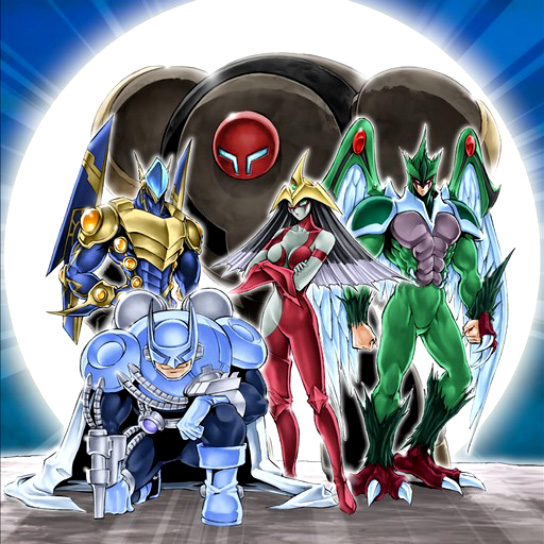
The reason I decided to keep watching GX was because I found it interesting how the main character’s archetype of cards was Elemental HEROes. Heroism in anime seems to have been a pretty popular topic, from stuff like One Punch Man and My Hero Academia breaking into the mainstream. I’m of the idea that stuff like superheroes and the like have purpose and relevance because there is both performance and practicality to them. The performance comes from the acting on of ideals, and being able to use those ideals to spread messages of positivity and hope–be it to kids, victims, or the person acting as a hero. The practical side of it is that more often than not, many people yearn to believe in something that can give to them. It could be supernatural, an idea, or even just an object, but being able to confide and rely on a concept or object to consistently give you a feeling or sense that you’re craving can mean a lot. A lot of people consume media because they’re bored and want to be entertained! What does entertainment do? It satisfies. And what better way to be satisfied than to be reaffirmed about something you believe in! Performance is a form of entertainment, and Yu-Gi-Oh, as a show, has honed that idea to a razor’s edge in terms of executing its ideas and themes.
When Jaden Yuki takes his first hard loss in his second year of Duel Academy, to someone who uses the same HERO archetype of cards he does, his cards fly completely unprompted out of his disk, and he falls dramatically on the floor. When he comes to, he’s standing and in another duel with a fellow student, only he can’t see the images on his cards. It’s an incredibly heavy handed way of saying he’s lost sight of who he is! But boy, is it not only straight to the point, but also plays inherently into the idea of showmanship. Even in defeat, even though he isn’t quite that graceful, and even though it definitely is not intentional on his part, Jaden is the purest example of a duelist as a performer. He has a natural charisma, as seen in the episode where he duels Tyranno Hassleberry, the feisty dinosaur-using Ra Yellow first-year who challenges him. Tyranno has a posse of impressionable first-years he managed to defeat and enlist as his followers in order to learn how to lead. Those same followers go from overbearingly cheering for Tyranno to falling into Jaden’s pace and eventually even cheering for him when he stays optimistic in the face of certain defeat, turning him into a natural underdog. Jaden really embodies his deck with his charisma and positivity, in a way that makes his first significant loss very relevant to his character development, even if we as an audience might have “seen it coming,” or thought “it was about time.” This is what performance as entertainment is all about though, because it allows us to disregard the obvious and just enjoy however those predictable ideas were executed if we liked how they were framed.
YGO as a card game with a seemingly endless amount of cards and evolving rules, is perfect for setting up comebacks and turnarounds in favor of underdogs, or giving cocky and unprepared players their just desserts. Yes, a victory can only just be a lucky draw away, but the same can be assumed about any piece of media that thrives on suspense. It’s the execution, or performance, that can really elevate even the most predictable and trite developments into something entertaining. YGO is a show that leans very hard into camp, and while humor can detract from suspense, if the audience is already expecting the result, then there isn’t any harm in it. I like to see villains lean into trash talk, especially when it’s just going to come back at them! It’s funny on a meta-textual level (dramatic irony), and seeing someone just ham it up can sell it even further. I think that there’s probably no stopping the YGO train in this lifetime. Kazuki Takahashi may have just wanted to make a cool comic about an ancient Egyptian spirit possessing a Japanese kid who plays card games, but by this point it’s spiraled into its own beast. Frankly, I think I will love it regardless of what form it takes, because in each of the incarnations I’ve consumed it, it managed to evolve into a meta commentary on how performance, and as a result: execution, are vitally ingrained into entertainment and how we consume it.
 Culture, the Wavey type