Original Story by: Tite Kubo
Written by: Ryohgo Narita
Cover and Interior Design by: Jimmy Presler
Translation by: Jan Mitsuko Cash
Published by Viz Media
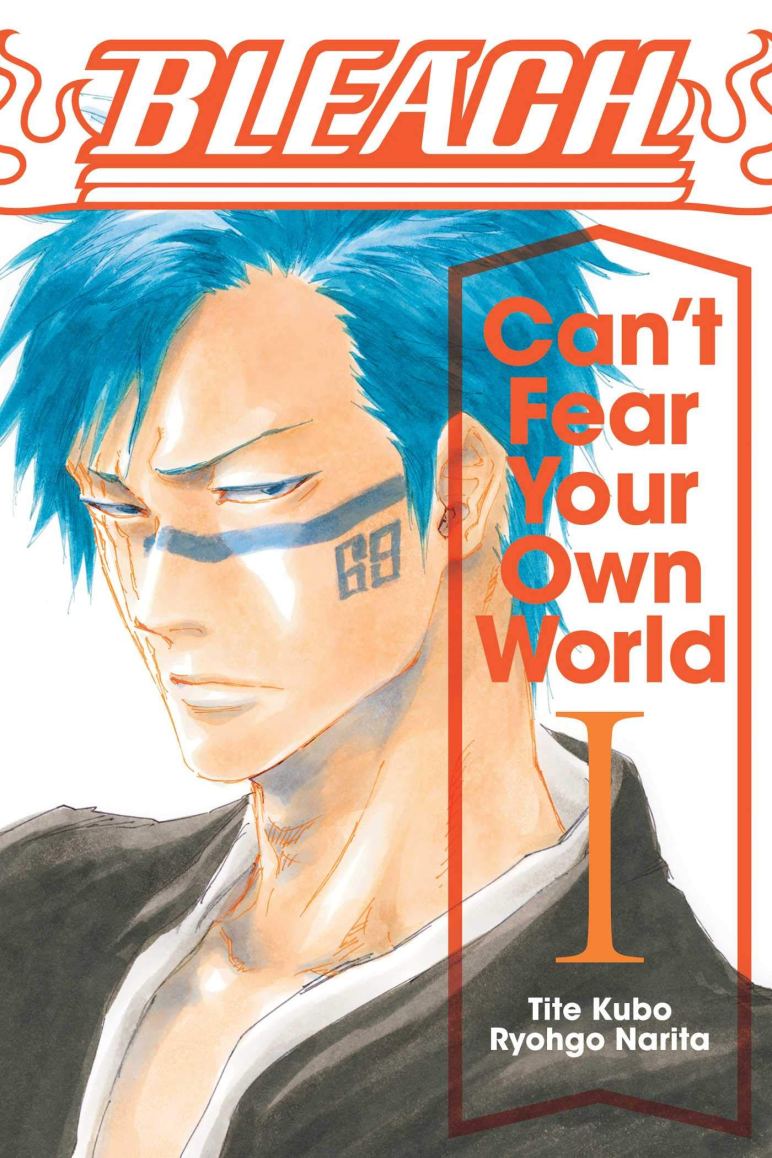
Just who is Shuhei Hisagi? The handsome, scarred and tattoo-faced, twin sickle-wielding vice-captain of the 9th Division has no doubt clawed his way into the hearts of many fans, but it’s tough to say whether or not he’s had much significance in the actual world and story of Bleach up to now. Almost as if to give us a reason to care, Ryohgo Narita, the original author of Baccano and DURARARA!!, goes out of his way to craft an entertaining, intriguing, and emotionally affecting tale that takes place in the world of Bleach after the manga’s final arc, with Hisagi himself in the eye of the storm.
After the events of the Thousand-Year Blood War, the aftermath is felt in every significant part of Bleach‘s worlds, from the Soul Society, where spirits go to in the afterlife, Hueco Mundo, the universe’s version of Hell, and the human realm. Ichigo and his main crew are nowhere to be seen throughout this whole book, and instead we are treated to delightfully diverse rotating ensemble cast within each of those three realms. There is a new character introduced, Tsunayashiro, whose background helps fill in details that were glossed over/inconsequential to the main story. However, retcon or not, it is a fact that his introduction helped propel the story, give context to previous tragedies that occurred, and motivate multiple characters to act in a way that befits their base nature. I was deeply impressed by the way that so many facets of the story–from Aizen’s recruitment of Tosen, parts of Kyoraku’s and other captains’ backstories, the history of the Four (formerly Five) Great Clans, and the aftermath of Reio’s condition–could all be neatly woven together with the existence of one man who up to this point absent. Of course, it could have easily smacked of hacky, “too-convenient” deus ex type of writing, but it remains that there are still mysteries to be unraveled, and the events have unfolded at a compelling and digestible pace.
Narita’s style of writing often jumps from different locations, characters, and time periods within a particular span. It’s very easy to to get lost with this kind of storytelling, but for the most part, the only details divulged are what the reader needs to grasp the context of what is happening, and, by the end of a segment, what importance it has after piecing all the previous events together. I have never fully watched nor read both of the series that Narita penned before, but I did understand why his style of storytelling was popular enough to bring his work over and also get adapted into other mediums, such as anime. I think that with Bleach‘s usual style of forward momentum in storytelling, having a new story that ebbs and courses in different narrative directions can help inject new life. To my memory, one of the most enthralling and engaging chapters for the Bleach community was the Turn Back The Pendulum arc, where we had negative chapter numbers for an in-depth flashback arc.
Besides the new characters, a great deal of enjoyment from this series comes from its widely varied cast, and in CFYOW, we get to see them interact in spades. There are many moving pieces, from the Arrancars who narrowly escaped death from Ywach, to the Sternritters who also survived by sheer coincidence, and even Fullbringers and people tangentially related to other minor characters, like siblings for Madarame or Hanataro. It feels satisfying to check in with most of them and at least hear a few conversations dedicated to the minority among the minority. I think that some credit for that goes to Hisagi’s involvement as a journalist and editor-in-chief of his squad’s press. A great deal of information we learn comes through Hisagi’s direct involvement, whether he’s in the background or actively pursuing information so that he can uphold his ideals of revealing the truth. Hisagi is surprisingly very charming. He has a self-awareness that he isn’t what you would call a “main character,” though not in those words. He compares himself to many people, and the narration goes out of its way to state the following:
“He did not have an unfortunate destiny like Ichigo Kurosaki.
Wow, Narita’s really hyping this guy up, even though he sounds pretty average. That’s how you know he’s a real light novel author…
He did not have the torrent of power than Kenpachi Zaraki contained.
He did not have the deep sagacity and groundwork of Kisuke Urahara.
He did not have a curselike curiosity etched into his konpaku like Mayuri Kurotsuchi.
He did not understand being continuously burdened with responsibility like Byakuya Kuchiki.
He did not have the resourcefulness to control multiple spiritual pressures like Toshiro Hitsugaya.
He did not have the time to lay the foundation of who he was like Genryusai Yamamoto.
He did not have the temperament to sidestep anything like Shunsui Kyoraku.
He did not have the passion to rewrite the justice of the world like Sajin Komamura.
He did not have the firm outlook to stick to his path like Kensei Muguruma.
Later, a Soul Reaper who knew everything about the conflict said this: Because he was him, because he was the Soul Reaper Shuhei Hisagi, he had exactly the qualifications the world wished for.”
This snippet might be a bit hyperbolic… Over-dramatic? Theatrical, even. But this is the kind of prose that I just eat up. I think what makes it stand out to me is the fact it goes out of its way to namedrop all these important–at the very least within the context of the story–characters who no doubt are all also popular in their own way, but because they all got their own arcs before this guy, Shuhei Hisagi. It’s like we’re being told, “Whoa, whoa whoa. Hold the F up now. I know you might be thinking all these guys are dope, but you see this guy right here? THIS guy, right here? He’s about redefine the whole game right now, and y’all aren’t ready.” And you know what? Maybe we aren’t. Or maybe we are, but it’s hard not to smile or be at least a little amused with this type of delivery, because it oozes enthusiasm on behalf of the author. It’s like a musician already aware what their last song is going to be, but they want to pump up the audience so they can scream for the encore and get the REAL finale. It’s almost childish in how straightforwardly unabashed it is, which, let’s be real, is the reason a lot of us enjoy action stories like Bleach to begin with.
Regardless, there are plenty of instances of genuinely engaging and at times flowery prose. When earlier I mentioned there being emotionally affecting scenes, I was not kidding. Often times, emotions aren’t usually explored in shonen manga, unless it’s for a big climax. Since this story takes place after the actual climax of the original manga, I wasn’t quite expecting to see characters stewing in their own emotional turmoil as they process the fallout of the war. Hisagi got a lot of his screen time originally because he was a vice-captain for one of the two who betrayed Soul Society with Aizen, Kaname Tosen. He is aware of his captain’s past, and the event that shaped the ideals he eventually inherited. Hisagi, being a journalist with ideals, shows exceptionally strong empathy–a trait that belies his usually harsh, scowling countenance. His initial encounter with Ginjo, the fullbringer who, wrapped up in a scheme with former captain Ukitake, was rocky at first, but it was satisfying to see the barriers gradually broken down thanks to Ganju and his sister Kukaku’s presence. It honestly makes me really happy seeing parts of the cast I would have never imagined meeting, to interact and almost bare themselves emotionally! I never really cared about Ginjo because I thought he looked like a tool. I know his story was sad, but I think that seeing it recounted in words, with some of the additional context we got from the final arc, made it genuinely tragic and allowed for the events to sink in better. There were at least two more instances of Hisagi being emotional or expressing empathy, but I think the part that did this the best was actually Tosen’s flashback.
Though Tosen could not see the other man’s expression, he could sense violence creeping into the Soul Reaper’s words. Oddly, it allowed him to regain his composure.
Bleach: Can’t Fear Your Own World, Volume 1, Page 54
He was barely able to suppress his own anger as he strung together a sentence while recalling his friend’s words. This world was far from what she had wanted if her colleague spoke with that kind of hostility in his voice. He desperately tried to reach an understanding within himself as he replied to the Soul Reaper’s question. “I don’t think she would want revenge. And if that’s how she felt, then I…”
But he stopped there. Then I don’t want revenge either.
He couldn’t manage to say it, even to himself. He knew she would never have wanted another person to sully their hands seeking revenge for her. But the emotions pulsing deep in his gut wouldn’t accept that as justice.
Her wishes have nothing to do with this. Seek revenge for yourself.
The lump of darkness that bubbled up within him was appealing, but Tosen could not follow that voice. Because he knew. The moment he or anyone else chose to follow that hatred, she would die again.
Even with just the short segment quoted above, it’s easy to see how much pathos is dripping from Tosen. It is genuinely enthralling to see this level of drama evoked from a single interaction. It’s very common for a lot of authors to hold off on killing their characters, or only do as such in order to elicit some type of reaction from their audience. Tosen is a character who, as Bleach readers, has circumstances we were vaguely aware about but accepted not knowing because the context wasn’t necessary in the moment. Seeing that context for the very first time, elaborated to this degree, was frankly unexpected and shocking. I think that by going the extra mile and actually tying this kind of past lore to events that are happening right now, is what makes Narita’s prose really stick the landing.
We know Kubo. He’s the type to sometimes forget things–like plenty of authors who have been doing a single serialized story for an extended amount of time. Sometimes he has to read through back volumes to find something that can be adjusted into foreshadowing, and while it’s not always neatly done, it’s the kind of attention to detail that fans do take to heart and appreciate. Ryohgo Narita is very obviously a Bleach fan himself. I don’t know how well known that fact was before this book, but I’m damned sure I’m glad that someone who puts in that amount of planning and exuberance into their writing is allowed to take the reins for a story. To my knowledge, there are two more installments of CFYOW. I will be waiting with bated breath for them to be released in English. I’d like to give a heartfelt shoutout of appreciation to Jan Mitsuko Cash for the translation, and whoever also helped edit. The dialogue was snappy and natural as can be, and the descriptive elements were vivid and easy to imagine. If you’re a Bleach fan, I highly recommend this novel, especially if you’re starving for new content while waiting for Burn The Witch and the anime relaunch.
Special thanks to Viz Media for providing a review copy. Bleach: Can’t Fear Your Own World Volume 1 will be available at digital and physical retailers on July 7th, 2020.
 Culture, the Wavey type