*This post has spoilers for Haikyu!! and Slam Dunk
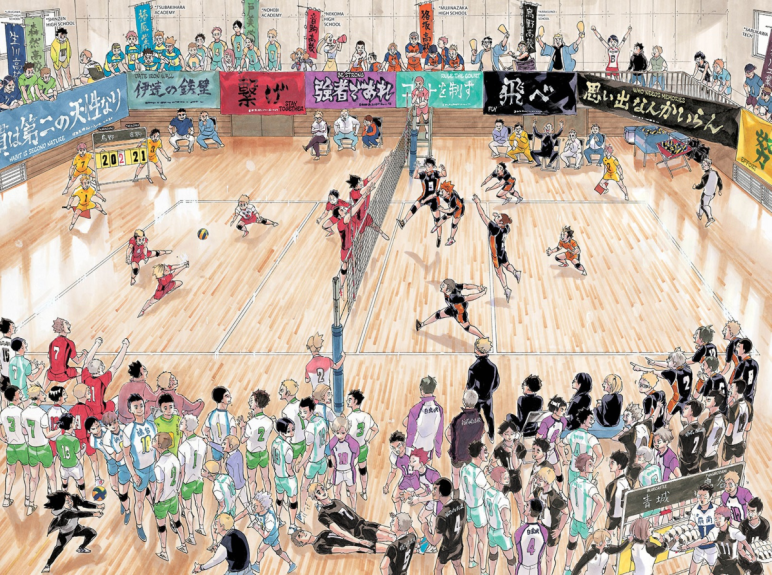
For the past year and a half, maybe a little longer, that I’ve been cohosting The View From the Top: A Haikyu!! Podcast, I’ve grown a lot more vocal and willing to tout it as the best comic in Weekly Shonen Jump within the time it’s been serialized. As of yesterday, July 19th–Monday the 20th in Japan–Haikyu‘s final chapter was finally published. Originally timed to match up with the Japan 2020 Olympics, before the spread of Covid-19 postponed all major events of the year, it was set to be one of the most incredible celebrations of the sport, ever. The anime’s 2nd cour of season 4 would have also been airing as well, if not for the pandemic. It would have created an unprecedented maelstrom of sheer hype, excitement, and unbridled love for volleyball, as the chapter itself echoed its refrain of themes.
For a long while, Slam Dunk had been my favorite sports manga of all time. It was always in the back of my head whenever I thought about how good Haikyu is, and I felt very guilty about not being able to stop associating Haikyu with it based on the simple fact that they’re both from the same magazine, and both such amazing stories. Part of it is largely imprinting, I know, but I’m sure that there’s plenty of other people out there with the same habit or worries. It feels hard to judge something on its own merits when there is a gigantic shadow looming underneath the history of comics that came right before you. After yesterday’s chapter, I could finally accept that those concerns were largely unwarranted. I wouldn’t say unnecessary, though. What we seek from things that we love is a sense of acceptance and closure, once we realize that they won’t be around in the present forever. Haikyu has been building and supporting the foundation for that sense of closure and acceptance for chapters upon chapters. As recent as the Brazil arc–where we saw the true consequences and implications of the Hinata’s ball boy arc–we were able to understand the true structure of Hinata’s journey.
Slam Dunk was great for many of the reasons that Haikyu is, namely–the focus on being a realistic take on a high school sport. Having a main character who gets enthralled by the sport, but doesn’t quite understand it like an expert, is the easiest but effective way to build an audience insert without being particularly boring about it. Sakuragi and Hinata couldn’t be more different as character personalities, besides the fact that they’re both stamina powerhouses and can jump really high. What makes following them very entertaining, is seeing how they fall in love with their sport, and gradually develop the drive to want to master it as an athlete. Drive and motivation are so basic, but key and formative in order to successfully participate in a sport. The way that both these series were able to harness that feeling and have it bleed from the page, is what lets us know as readers that Takehiko-sensei and Furudate-sensei both adored and put everything they had into their experience with sports. Loving something and being able to express it are two completely different things. Being able to do both is what makes the difference between a decent sports story and a spectacular one.
In terms of personal stories, the reason I could resonate so much with Slam Dunk was the singular focus on Hanamichi Sakuragi and his love for basketball blooming very gradually, after starting his athletic journey for reasons unrelated to anything we’ve talked about. Setting the stage by having a character who isn’t even that interested in something, but eventually becoming enamored to the point of obsession, is very thrilling. Shoyo Hinata starts at a very different place, having been enthralled at a young age but unable to cultivate the skills or friends to share in his love for volleyball until high school. That both of these characters were able to foster their talents through hard work, and arrive at the conclusions that they do by the end of their series, is magical to read. Part of what makes Slam Dunk great is the poetic decision to stop the story where it does–after Sakuragi performs feats that display the raw effort and honed skill that was drilled into him, and accepted personally after finding his core motivation to continue. It ends after that desire and dazzling triumph culminate in an injury threatening to his future athletic career. Haikyu gives us that moment several volumes before the end, and decides to keep going.
The decision to forgo the rest of the high school experience is meaningful, because it reveals a layer to Hinata’s character arc that separates Haikyu as a different sports story altogether. By deciding to move to Brazil, a volleyball mecca, and going out of his way to seek what he lacks, Hinata takes his journey as an athlete to a completely new stage. One of the most profound statements in the series is a simple one, given by Hinata’s club advisor and teacher, Ittetsu Takeda. Being told “Right now, this is volleyball,” immediately after his injury, Hinata was able to understand that a sport is more than just the time you spend on the court or field. Taking the effort to care for your body and nurture it, to be able to understand your limits, and reasonably improve yourself without breaking yourself down–that is the secret to forging athleticism. Patience is not only a virtue, but the standard. In Brazil, we see Hinata’s diligence in cultivating his body, mind, and will from the ground up, through the use of dietary habits/exercise, meditation, and consistency in routine. It gives us as readers a reasonable and believable explanation for how someone who grew up so starstruck and enraptured by volleyball was able to finally reach the level he strove towards. It was realistic. It was acceptable. It was satisfying. It made sense! It was moving! It was the best possible way to illustrate Hinata’s growth as a person and not just the audience insert or an athlete.
There is something deliberate about the pacing that Haikyu takes, and sincere about how its characters are handled. There were other members of Sakuragi’s team in Slam Dunk that got their focus, like Mitsui, Miyagi, Rukawa, and Akagi. But Haikyu‘s cast is sprawling, as evident through the scores of fanart online and even offline at self-published events. There was an abundance of diligence and emotional investment allotted into the cast, which allowed readers to gush over and discuss week-to-week, as the final arc reintroduced plenty of characters who continued or moved on from volleyball. Those characters grew into people with careers or stories of their own. The singular difference here is that Haikyu became a story with more ambition. It became a story about volleyball as a celebration of life, and how the many people in the story used the sport as a conduit for their relationships. The final chapter of Haikyu is so perfect because it’s the ultimate example of having your cake and eating it. So many characters have moved on with their lives, but are still in contact with the rest who have decided to continue pursuing the sport. There is an explanation in narration boxes about what the sport is, toward the end of the chapter, and it goes:
Haikyu... Also known as volleyball. Two teams separated by a net... Bounce a ball back and forth between each other... The ball is not allowed to touch the floor. It cannot be carried. Once it is in the air, a team has no more than three touches... to connect. And take the ball from receive... to attack.
It’s so simple but so succinctly executed. The text is gradually posted alongside some choice action panels of an Olympics match between established characters. It was immediately following another wonderful quote that went “Yesterday you were the defeated. What have you become today?” Haikyu is always about connecting. You make contact. You move. You score. You lose. But the game–and life–continues, and you have the choice to also move on. You can receive what’s thrown at you. You can also retaliate.
This simplicity in its straightforwardness is the appeal for tons of shonen manga. But being able to thematically thread these ideas coherently, visually–through smart storyboarding and composition–and to continue doing it so consistently; this is what separates the good from the greats. Haikyu has already made its impact on the sport of volleyball in Japan, much like Slam Dunk did for basketball. I think that its influence will no doubt linger just as long on the public’s consciousness. I love Haikyu so much so, that it was really hard to put into words what this series meant to me up until this point.
I want to thank my every one of my friends at the Haikyu Podcast. Kendra for spearheading and handling logistics of the project. Lisa for the editing and embodying the fervent desire to create and share that comes from fandom. Ash for providing a standard when it comes to writing and being able to articulate emotions and analysis in a purposeful way. Kari for showing how the different avenues of fandom can enhance and provide a uniquely rich experience. And Gabi, for acting like the glue and encompassing all of those traits through her sheer admiration, appreciation, and sincerity for the sport, the craft of creation, and the many facets of art as a medium. I also want to shout-out everyone else who guested for us, including but not limited to BMC, Lucas, Sam, Kadeem, and many others. For helping me organize my thoughts prior to writing this, I also want to extend a heartfelt thank you to Sakaki and Cresse. Obviously, anyone else who I talked about the series with and was able to discuss, analyze, appreciate, and just gush over, is up there as well. Thank you for reading, thank you if you’re a Haikyu fan, and thank you to Furudate for all you’ve done. It might have felt insincere or disingenuous to see so many comparisons to Slam Dunk in a Haikyu post, but I firmly believe it’s possible to compare without quantifying. At this point, I don’t know if I could call one series better than the other, but what I can tell you is how dear they both are to me. I will love Haikyu!! for the rest of my life.
Haikyu!! is available in its entirety on the Shonen Jump website and Viz.com–both of which are also on mobile by browser or app. Internationally, you can find it on MangaPlus or on Jump+ in Japan. You can also buy Haikyu!! in print in paperback at retailers like Amazon, Barnes & Noble, Books-A-Million, Bookshop.org, RightStuf, Walmart, and Comic Shops, or digital retailers like ComiXology, Google Play, Kindle, iBooks, and Nook.
Special thanks and an appreciative shout-out to Adrienne Beck for your hard work in translating Haikyu!! into English, and Erika Terriquez for the phenomenal follow-up on lettering those words. Together, your work has exceeded the sum of its parts, and undoubtedly enhanced and elevated the reading experience for Haikyu!!‘s English-speaking international audience.
 Culture, the Wavey type