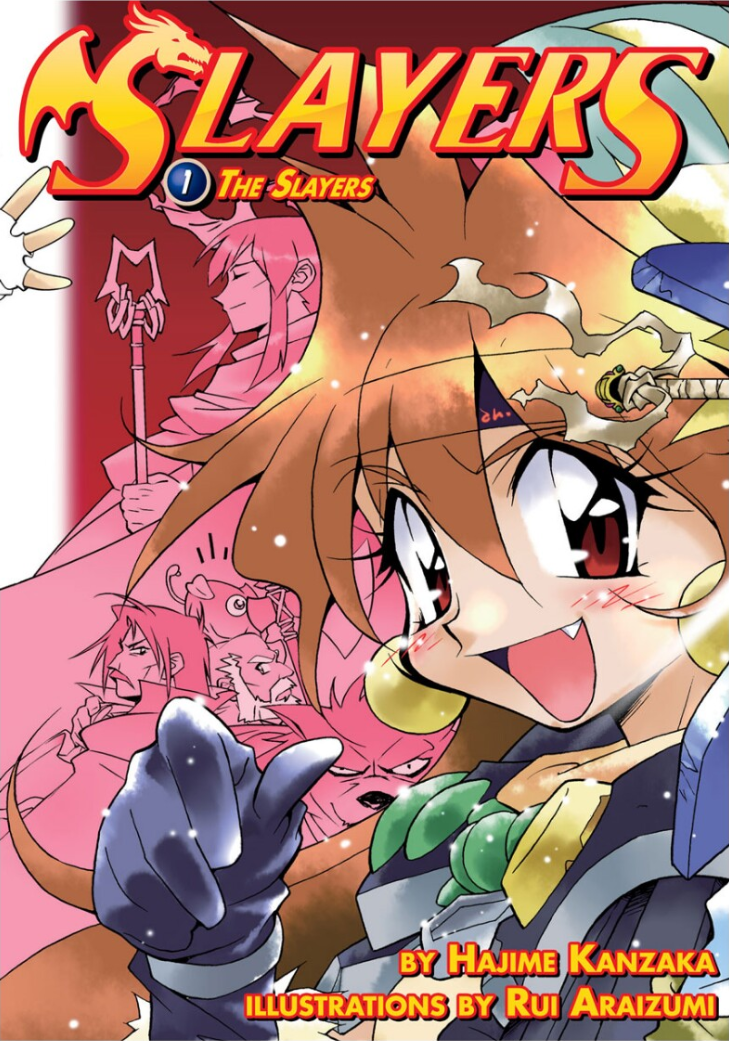
Author: Hajime Kanzaka Illustrator: Rui Araizumi Translator: Elizabeth Ellis Editor: Megan Denton
A cursory Google search can tell you that it’s been roughly 50 years since the advent of tabletop role-playing games. Originally an offshoot of war-games and strategy games like chess, they gradually evolved to become storytelling devices, with character writing, elaborate settings, and individualism at the forefront of decision making. As these games got more intricate and imaginative, people began to delve into more fantastical, creative backstories and settings for their stories. Slayers is a story that feels very inspired by that trend in gaming and fiction. To this day, there are still many written tales coming out, that are woven from the same cloth as Slayers, and people who still love to consume media inspired by those influences. I may have missed the boat when it came to the animated series for Slayers, but now that J-Novel Club has rescued the license for the novels, plenty of people will have the chance to experience or revisit this ’90s mega-hit.
As a completely blind reader, I was not really expecting anything in terms of what kind of story or style of prose this could be. The fact that it was a comedy, and a parody of High Fantasy at that, in retrospect should have been obvious from the promo material and character designs. For the most part, the comedic beats are executed finely. There are plenty of familiar plot and character beats that help the narrative momentum plow through most of the exposition. What makes Slayers work as a comedy is the fact that most gags are one-and-done, while keeping a handful that are gradually built upon like a chained combo at an arcade fighting game. Just like the ’90s!
Speaking of 30 years ago, off the top of my head, there’s only one distasteful joke which could be explained as a “sign of the times.” It’s roughly 2/3 in, where Lina is captured and verbally threatened with the prospect of rape. The threat itself is shrugged off because no one actually wants to do it, and when a monstrous Fish-man decides to step up, the follow-up joke is that fish copulate by fertilizing eggs outside the actual body. It’s extremely bizarre, and it felt as if part of the humor was intended to come from how this group of bad guys in particular just aren’t that evil, but it’s really hard to see it in 2020 without raising eyebrows. This is the only time when being a comedy made such a slip that much worse. Knowing that the threat itself is nonexistent does very little to excuse the fact that an act as heinous like rape was used as a punchline. It could arguably have been used as a plot device to heighten the stakes, but immediately undercutting it with humor immediately denies that tension, and comes off as even more crass. The fish egg line got a reaction from me because of how strangely timed the subversion came, but it didn’t make it less gross. Plenty of modern stories still handle rape and sexual assault lightly. The fact that this came out 30 years ago just marks it as one of the reasons why.
Lina Inverse herself, as a character, is plenty engaging and fun as a point-of-view character. She is intelligent, crafty, spontaneous, and quick-witted. All of her interactions are full of spunk and zeal. She is not purposefully heroic, but that is exactly what makes her heroic stand-offs compelling. I really like the fact that she is well-versed in history, magic, and even swordsmanship, because it allows her cocky attitude to have a believable foundation. Her actions dictate all of the major story events, and it’s entertaining to see her start and end the initial conflict that extends through all of this first volume, very much like an actual tabletop rpg fantasy story. She is capable enough to use offensive and support magic, and by using her wits she can bounce back from most lapses in judgment. Honestly, she could have come off as a Mary Sue if she didn’t have such a loud personality, and the faults of a normal person with an ego! The fact that she doesn’t, however, is owed to the fact that her character flaws are worn on her sleeve–the other cast members never hesitate to bring her down a peg for being a narcissist. It’s a dynamic that you can easily find in slightly more recent fantasy comedies like Konosuba, The Devil is a Part-Timer!, or Miss Kobayashi’s Dragon Maid. For these stories, a sizeable chunk of the humor comes from the characters instigating each other with some self-awareness. There isn’t too much maliciousness; it’s more like a “Teehee!” with a wink and tongue out, as the prose nudges the humor out of the banter.
As far as the story itself, it’s standard fantasy fare, with plenty of repurposed ideas slightly contorted to fit into Hajime Kanzaka’s tastes and vision. I thought it was fairly impressive how the first volume already had a fight against an evil God! Even though the focus of most comedies aren’t in the action, the fact that Slayers went out guns blazing from the start was great. I’m expecting future stories to be a little less epic in terms of scale, but this does open the door for a lot of possibilities. I also appreciated how bizarre some of the names got. To my knowledge, we didn’t exactly get everyone’s full names from what was written in the pre-pubs. This could change in the volume release with character profiles. Regardless, what we did get to see was still fun and interesting. From first names like Zelgadis to Gourry, to titles like “Ruby-Eye Dark Lord, Rezo Shabranigdu,” to phrases like “Zanaffar–the demon-beast that razed the Magic City of Sairaag!” These names so nonsensical with a very typical high-fantasy flavor, such that if you’re used to these kind of stories, just a glance will probably bring a nostalgic smile to your face.
Slayers is as much of a jab at these classic fantasy tropes as it is an unabashed celebration of them. It should go without saying that tropes become what they’re perceived as because of the fact that they work as vehicles for storytelling. There are plenty of stories that get bogged down by their extended usage, or reliance on them to carry shoddy writing. Being able to move align tropes at the foreground of your story without using them as crutches or outright rebuffing them is a hallmark of many great and popular parodies. Slayers indeed is just that. Aside from the tactless joke about sexual assault, Volume 1 was a thoroughly likable and enticing read. I would gladly recommend it to people who are fans of lighthearted fantasy comedies, with the added caveat about the rape joke. You can read Volume 1 right now in 4 parts as a J-Novel Club Premium member, or you can pre-order it at these online retailers to read when it goes live on sale, August 17th, 2020:
iBook
Nook
Kobo
BookWalker
Amazon
J-Novel (Premium, DRM-Free)
This review was written using J-Novel Club's Pre-Publication release. The author of this review is a J-Novel Club Premium member.
 Culture, the Wavey type