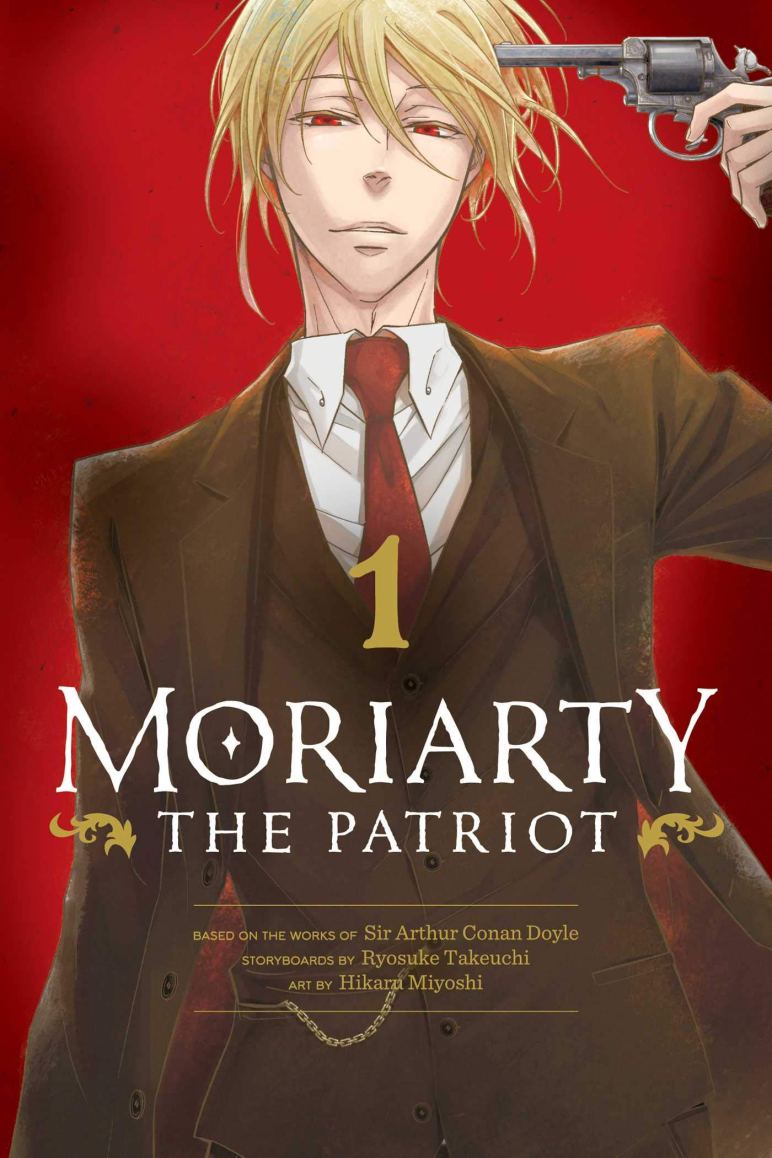
Based on the works of: Sir Arthur Conan Doyle
Storyboards by: Ryosuke Takeuchi
Art by: Hikaru Miyoshi
Translation: (´・∀・`)サア?
Touch-Up Art and Lettering: Annaliese "Ace" Christman
Design: Joy Zhang
Editor: Marlene First
Among the many things I read, there are some genres I dip my toes less and less into, over time. One of them is mystery, partly because I understand an inherent appeal to it is being able to follow the clues alongside the text and solve it yourself–and I don’t usually do that. Moriarty the Patriot, being based off the infamous villain of Sir Arthur Conan Doyle’s mystery novels, initially had me apprehensive over whether or not I could enjoy it as well as any mystery buff, or a sincere fan of Doyle’s work. After gritting my teeth to sit down and read, I can gladly say my worries were unfounded.
William James Moriarty, as a character in this manga, appeals to fans of series such as Death Note and The Promised Neverland. He is incredibly smart, self-aware, and above all idealistic. Adopted into a noble family shortly after the industrial revolution, he acts as a consultant for people while doling out punishments to corrupt nobles from the shadows of society. I was impressed two things about how his character was depicted. Having cultivated so much knowledge since childhood, his awareness of the moral stagnation and rot in upper society, the way that his decision to kill in order to reach his ideals is very fascinating. Normally, idealism is used as a reason for a perspective character to be pacifistic or denounce killing, but like Light Yagami, he views death as a tool to help achieve what he wants. This is the kind of behavior we also see from a human faction in the final third of The Promised Neverland. Frankly, I find Moriarty more interesting as a character than Light, because the application of these ideals in a class-oriented society has a lot more thematic weight. When weighing the sins of the rich and oppressive against the poor and destitute, it’s easier for a reader to forgive or even root for protagonists who murder. Light’s ideals applied to modern society were mostly selfish because he was killing people he’d seen or researched by TV or the internet, instead of seeing actual harm caused to citizens in person. Moriarty’s explicit involvement with common people sets him apart from the noble class he’s judging and also taking advantage of! He’s like Robin Hood but with a gun. Except the gun has a silencer. And it’s wielded by his friend from the military.
There are only 3 chapters in this premiere volume, but each are very dense and tell a single story revolving the Moriarty–in this story, he is the adopted middle son of Count Moriarty, originally an orphan–and how he deals with corruption. As a semi-historical manga, the tacit acknowledgement of how the British Empire changed the landscape of class culture with the advent of the industrial revolution was appreciated. The rich became richer off the backs of the working class, and with the luxuries of mass produced exports also came the spread of drugs from overseas, like opium, becoming rampant. In each story, Moriarty investigates and targets a particular noble-class figure who is deserving of “punishment” according to his ideals. The punishment comes in a form of death, executed as a “perfect crime” which can lead to no traces of premeditated murder, only leaving suicide or accidents as results for the autopsy.
Even though this series is originally based off of mystery novels, it isn’t particularly that brand of story. The way that the murders are executed skew much closer to spectacle than a thriller story. Watching the plans that Moriarty creates gradually unfold, it feels like the author pulling on a ribbon to unwrap a gift, and revealing a Rube Goldberg machine that ends with a piece of Mentos falling into a 2L Coke bottle. The resulting geyser is a metaphor, for poor people popping champagne bottles in the homes of the evil rich people who just died. Jokes aside, it’s very entertaining to see elaborate schemes executed! Given that there are only 3 chapters in this 210 page book, there was plenty of time to let the story and contents breathe as the narrative was set. The pace at which we expand the world has been enjoyable as well. Chapter 1 was essentially an origin story, Chapter 2 took the story to a new region that the Moriarty family now governs over, and Chapter 3 focused on a locale in which Moriarty works at within that region. As readers, we get gradual bits of information on stuff to set up the shift in class dynamics, such as the Pax Britannica, and the intent behind alumni donations to Durham University. It makes the ensuing events feel unavoidable, as every cog in society exists solely to propel the machine that is social class. Moriarty’s outright disdain of it emotionally influences his older brother, which is the only reason he’s able to weaponize his intellect for the sake of class warfare. It’s a very fascinating dynamic!
As a whole, I very much enjoyed the first volume of Moriarty the Patriot. Aside from the mystery genre origins, I was also kind of worried about the “Patriot” in the title. Nationalism is something that can be venomous, and for the most part, I understand the meaning behind its inclusion in the title. Moriarty’s brand of patriotism comes from his desire to make his country, and the world, a better place. It’s not as if he’s killing his victims in the name of his Oh So Great country, and neither does he outright call himself one. It’s more to frame the character as righteous in a way that his actions don’t necessarily imply outwardly. This story also being semi-historical makes those not-quite nationalistic undertones easier to stomach. Whether or not it comes off as romanticizing for the era will depend on the reader, personally I did not get that impression. If you are a fan of suspense stories in the vein of Death Note, The Promised Neverland, and even Psycho-Pass, I think you might enjoy this series.
This review was possible thanks to VIZ Media for providing a review copy.
 Culture, the Wavey type