Hello everyone, things have been quite busy recently. Aside from day-job things, I’ve had the pleasure of getting into contact with Irodori Comics. They license, translate, and publish doujinshi, or self-published works from Japanese artists. It’s essentially the comic equivalent to indie video game development, because artists create and publish these manga without the help of a major publishing company. Usually, doujinshi are created as a way for artists to make supplemental income, or express themselves creatively without the restrictions of a commercially serialized manga, or both! Frankly, it can be a very fascinating look into an author’s id and the kinds of ideas they may bear or want to express, but haven’t quite grasped how to integrate them into a more commercial work. Today, I’m very proud to bring to you my thoughts and impressions on not just one, but two doujinshi created by Isaki Uta, who is also known for Generation Witch. Now, without further ado, let’s get into it!
Mine-kun is Asexual

Original Story & Art: Isaki Uta
Translated by: Ed Ayes
Lettering by: Tim Sun
Compiled and Formatted by: CC Sū
Quality Assurance by: On Takahashi and Zhuchika
Our first book is about something near and dear to me–LGBT content! Mine-kun Is Asexual is told largely from the perspective of Murai, a girl who is absolutely infatuated with the titular Mine-kun. One evening, while dining together at a pub or restaurant, Murai drunkenly confesses her love for him. He responds in turn by telling her he is asexual, only being romantically attracted to people–biromantic in this case–but uncomfortable with physical sexual acts or displays of intimacy. If Murai were fine with that, then he’d have no issue with actually dating her. Having been presented the chance of a lifetime, she jumps on it!
This was a very cute, albeit bittersweet read. Right off the bat, it goes for a more lighthearted feel, with Murai’s confession being painted as slightly over the top and aggressive–her passion leading to some blushy, teary-eyed babbling after internally gushing over all of Mine’s attractive points. The comedic bits are accentuated by some very smart paneling decisions, like using widely zoomed reaction faces or super-deformed character portraits to underscore the lighter tone of a particular scene. It’s endearing to see Murai attempt to be considerate of Mine’s needs and preferences! It’s very clear that she struggles a bit with her own sexual desires clashing against Mine’s lack of any, but her love and respect for his agency means that she’d never willingly violate that distance.
I think one of the biggest challenges that might come with portraying asexuality in media is making sure that the character in question doesn’t come off as robotic, or devoid of any actual emotion, because many, many people conflate sexual desire with romantic desire, leading to confusion. Mine-kun has hobbies and interests–he’s a huge Marvel fan, and likes to cook! He’s also expressive, and smiles or gasps when he’s happy or shocked. He also feels a very personal sense of confusion and dismay at being so different from what is perceived as normal, like every other LGBT person out there. A contender for my favorite scene is around Page 22, where he questions Murai about what it means to be normal, and muses about what inherent things he is lacking in order to meet that classification. But even if he’s not “normal,” he does get a sense of gratitude for finding someone willing to pursue a relationship with him in those circumstances. At the end of the day, all that we–as people–desire, is connections. Intimacy in the form of sex is one way many people express that, but while Mine doesn’t desire that, he still appreciates having a connection to Murai in the form of his relationship with her. It’s what leads to his very bittersweet end to that saga in both their lives.
Both parties are aware that they can’t seem to provide the exact kind of relationship the other needs in order to thrive, and it ultimately leads to their breakup. The true catalyst was actually Murai’s friend, who Mine overheard talking to her, bringing up the idea of breaking up because Murai feels lonely. Mine brings up the idea during a movie night at her apartment, and Murai responds with “I’ll do it if you kiss and embrace me just once.” It was a challenge she herself didn’t really want him to step up to. She may not have been sexually content with her relationship, but she still treasured him, and thought that by egging him on in this way, she could keep the status quo in-tact. But Mine really did care for her, and decided to purposely appease her desires at least this once, so that she could pursue someone who could satisfy her in a way he was unable to. Murai’s inner monologue immediately cutting short to Mine’s affirmation to do that for her was really striking. Her tears came out involuntarily once she realized she made a mistake. The internal monologue stating “In this moment… I wouldn’t mind if the world… came to an end. I wonder if you felt the same…?” naturally comes from Murai, but with the context of how we’ve seen Mine respond emotionally to everything around him, it can easily echo as true for him as well. In their final moments as a couple, they were able to understand each other on the deepest emotional level they ever reached.
Mine’s post-breakup commute back home, pondering about the items he left with her and when/if he’d ever get them back, is a painfully and emotionally accurate experience. It’s also when he is hit with the full brunt of realization that he loved and cherished Murai. It was so sad that these two couldn’t make it work, but this is just another facet of life. Relationships don’t always work out, and that’s okay. We learn later after the afterword, that she did end up returning his blu-rays, but kept his bread container (lol), and that they both moved on with their lives and Mine ended up meeting someone at an IRL Ace meet-up and was happy ever since. Also, Murai’s friend was a lesbian who used to be into her! Those were some colorful and very appreciated tidbits. The actual afterword itself was also great to read. In it, Isaki-sensei goes to length about discovering asexuality and feeling a sort of affinity with it. There might be some overlap between them and Mine’s character, but ultimately they’re different people, because asexuality can mean different things depending on the person.
They’re not an authority on sexual minorities, and this is ultimately just a doujinshi, meant to be taken as a creative outlet for this particular creator to explore themes and ideas that they want to draw. They did, however, recommend any folks who are interested in learning about sexual minorities (in the context of Japan) to read manga made by Sho Arai. A cursory search will show you that they’re an intersex person who created Seibetsu ga, Nai! (I Have No Sex!) which recently got a crowdfunded documentary film in 2018! We love to see it.
Mine-kun Is Asexual is officially published in English by Irodori Comics! It’s about $7.25 USD for 47 pages, but because this is a doujinshi, a bigger chunk of the money will go to the creator, because they were negotiated with directly, and there is no middle-men beyond the English publisher and localizers themselves. I was informed by their representative that at the very least, 50% of each purchase goes directly to the author–that’s probably the highest in this industry! Every purchase on their site also comes with DRM-free digital downloads, so you can read it on any device or platform that can read the file format!
Mermaid In The Bottle

Original Story & Art: Isaki Uta
Translated by: Ed Ayes
Lettering by: Mercedes McGarry
Compiled and Formatted by: CC Sū
Quality Assurance by: On Takahashi and Zhuchka
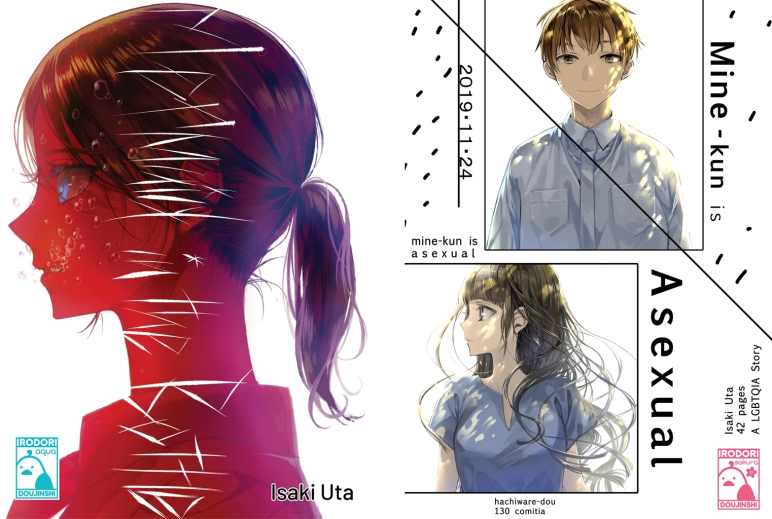
First of all, let me just get this out of the way. I really enjoyed Mine-kun is Asexual. It was a touching, bittersweet story that portrayed asexuality in a light that didn’t necessarily make ace people look like some inherently broken, confused existence that must be fixed in order to function in society. As a purely artistic endeavor, however, I was absolutely enthralled by Mermaid In The Bottle. It was such a strange, interesting setup, and drawn with an artistic flourish that amplified the characters’ emotional states in really creative ways. I think it’s clear just from the covers that these two books are tackling their thematic content in different ways. Mine-kun‘s cover has the two main characters in window portraits, with a line crossing Mine’s to illustrate there is something different about him compared to Murai, whose portrait is untouched. She is also facing away from the camera, presumably looking at Mine-kun himself, but perhaps only at the part that the light is hitting or he presents to the public, as she didn’t know about his sexuality until she started dating him. For Mermaid, we see a side facing portrait of Ayumi, in a dark crimson gradient as she’s breathing out air bubbles. The title itself is stylized in its lettering to look like cuts. At first, I was wondering if this story would be about self-harm, thinking that the cuts might be scars. They indeed are scars, but of a different origin.
Mermaid In The Bottle is about two siblings who work for their mother at a self-made beauty company. While on an errand to check their sample inventory, they find a bottle of lotion that has a living mermaid, the size of a small hand inside. (The reason provided for this is that the lotion was made using ocean water.) Hiding this secret allows them to reconnect as siblings and address their own personal falling out, after their parents got divorced and they began to live with different parents. The tone of this book isn’t that heavy right from the get-go, but gradually seeps into it, giving the reader a feeling like they’re being submerged underwater, like Ayumi in the cover. Takeru, her brother, is the POV character, and we learn from his perspective that he wrongfully interpreted how the events in their lives had lasting effects on his younger sister. She suffered a sports injury that made her retire from pursuing that at school, and leaving her to live with their mother, after he chose to live with his father, was the opposite of good for their mental health.
Seeing how their mother acts around the workplace makes it easy to imagine what it would have been like Ayumi to grow up with her mom in a two-person household. Isaki-sensei presents all of this information very organically through conversations and implications. In the afterword, they were worried that it might have been too vague, or that not having an editor, like they would have if this were a commercial manga, may have made the story harder to follow. I politely disagree, Isaki-sensei. There were some very tasteful transitions and scenes done with the use of screentones and shading that covered, spread, or even completely drowned characters in a way that perfectly illustrated their emotional state. I am confident when I say that even if a reader may not have picked up on a specific nuance for an event or statement, the characters themselves were able to clearly express what they were feeling to the reader, regardless of if the other characters around them were able to pick up on that due to the story itself.
THERE’S JUST SO MUCH MORE I ALSO WANT TO ADDRESS! There’s a plot thread of Takeru finding trails of embezzlement, thinking that it was his mother after she got things like Botox and nose-jobs. He finds out later that the money was actually stolen by Ayumi, as revenge for being abandoned, and to stick it up to her mother for all the abuse she suffered over the years. Takeru tells her he’ll keep that secret to the grave, and goes his separate way again, after they release the mermaid back into the ocean. The moment they hold the bottle together and warn it not to get caught again is basically Ayumi talking to herself. She sees herself in the mermaid, being caught and forced into something and having the rest of her life dictated by other people who hold more power than she does. After her injury, she lived a passive existence, wallowing in her own misery and being unable to move on and find the joy in something. It’s a very real and visceral emotion that anyone can feel when they are stripped from the one thing that they care about the most. At the end of this interaction, where they split up, Ayumi says that she loved him. She felt like a broken person, but found solace in knowing that her brother would recognize and acknowledge her existence regardless. The confession is framed by the image of the mermaid’s tail peeking from the waves, as the sun sets in the horizon.
Takeru remembers that the sport his sister used to do was swimming. On that page, page 37, the memory comes back to him as he recites the events that happened after his sister disappears, and his mother’s business gets swallowed up by a competitor. There are gorgeous ferns and plants framing the page as the narration is spoken over panels of his sister’s younger face and body, with inverted colors (white lines over black background). The next page is him sitting hunched over while smoking at a window with the same plants at his backside. The window now frames him as looking trapped, with black bars and the plants being equally blacked out, but the cityscape beyond is lighter grey. The final shot is his sister walking along the beach with a dog, their legs all being shaded by screentones to depict shadow, but also giving Ayumi the impression of having scales, like the mermaid.
This book was so beautifully presented. I would have been happy with just that. But there’s an epilogue! And we get to see the siblings reunite after two years! Takeru almost drowns and gets saved by Ayumi, who has a mermaid tail that disappears once she’s on land and Takeru regains consciousness. It was cute how she left to go find his bag, still in the ocean, but he grabs her foot and laments, “don’t leave me.” It’s selfish, especially after leaving her twice, but there was never any actual bad blood between them. Ayumi gives a troubled smile and goes after reassuring she won’t leave him. Ending panel is Takeru trying to move but still stuck on the sand. It was a sweet and heartwarming conclusion that I really appreciated.
There’s an afterword where Isaki-sensei talks a bit about Ayumi and their attitude about working on self-published works without the help of a professional editor. It’s some really neat insight that can help readers contextualize the creative process that goes behind comics-making when the author is also the artist. The final page is a color illustration of Takeru in a similar gradient to Ayumi in the front cover, but in a deep blue, with the same stylized letters of the title over his face. This could be taken to mean he’s accepted his sister’s scars and is just “as deep” in her circumstances now, instead of being uninvolved like when they were growing up. Their relationship is kept pretty vague so it’s easy to imagine there being or not being any kind of incest. That kind of vague portrayal, in my critical opinion, is completely fine for what this work was trying to do. Both Ayumi and Takeru are serious and hard workers, and their strained relationship, created by their parents dynamics between them, is delicate and messy. Isaki-sensei was able to put their feelings on these pages through really detailed and nuanced expression work and with the use of screentones and backgrounds that helped contextualize their feelings without necessarily having to spell it out in words. I would recommend this work to anyone who wants to see the comics medium being pushed in a unique way.
Mermaid In The Bottle is available on Irodori Lite, for $5.45 USD as a DRM-free digital purchase. It’s about 47 pages, but well worth the investment–seeing as officially licensed doujinshi means artists will make more money from each individual purchase. These works were also made without the help of assistants, and therefore took longer to make.
I hope you’ve enjoyed this foray into the world of self-published comics! I believe that they’re a testament to the fact that length has no say on the actual quality of any work. There are many reasons to like many different things, and if you have a favorite artist in particular who makes self-published works, make sure to let them know you appreciate it! It isn’t easy to consistently create things without the backing of others, which makes discoveries like these shorter comics by Isaki Uta that much more impressive.
*This review was possible thanks to Irodori Comics for providing review copies! Mine-kun Is Asexual comes from their Irodori Sakura imprint, and Mermaid In The Bottle from Irodori Aqua! You can also follow the artist, Isaki Uta on Twitter!
 Culture, the Wavey type
One thought on “Isaki Uta and Freedom of Expression | REVIEW”