
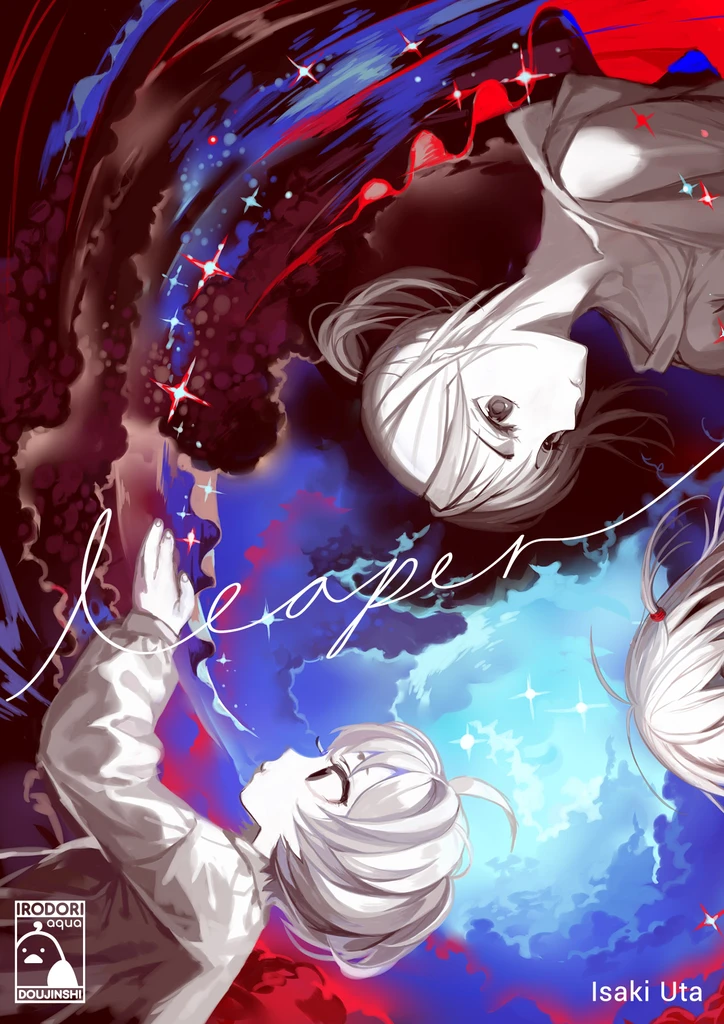
Original Story & Art: Isaki Uta
Translated by: Ed Ayes
Lettering by: Tim Sun
Compiled and Formatted by: CC Sū, Katarina Kunstelj
Quality Assurance by: Zhuchka, On Takahashi
Doujinshi are magical. There’s a breadth of things that can happen in the span of however many pages in a book, and the nature of being self-published means that an author can just let their mind soar. Isaki Uta’s Leaper is a one-shot story that premiered ten years ago in Monthly Afternoon Magazine, jump-starting their career as a professional mangaka after winning an honorable mention. Previously, I was fortunate enough to cover Uta-sensei’s Mine-kun is Asexual, and Mermaid in the Bottle–both being much more recent works that display their refined sense of storyboarding and art. Going back to any artist’s roots means being able to notice details and purposeful actions or habits that turn into quirks and hallmarks of their style. I’m happy to report that plenty of things I really appreciated from Uta-sensei’s other work is also present in their first published work!
Monthly Afternoon is a Kodansha imprint that might not be as well known in the West as much as Weekly Shonen Jump, or even its sister magazine, Weekly Shonen Magazine–but hearing that this one-shot was originally published there immediately made sense to me once I finished reading. I associate Monthly Afternoon with stories that are unafraid and willing to dive into the emotional core of what makes a character human, or understandable–usually in correspondence to their relationships with others. Some titles you may recognize as currently being serialized there are Vinland Saga and Land of the Lustrous, which are more action oriented but also delve into their protagonists’ psychological and emotional states. But this is also true of other non-action stories published there, like Big Windup! (Ookiku Furikabutte) (Sports), and Mysterious Girlfriend X (Romance), and many others. Now, I’m not saying this is some kind of definitive requirement for every series in that magazine, but that the tone of what we got with Uta-sensei’s Leaper definitely meshed beautifully with the vibe that magazine usually goes for. It’s not surprising to me that it was well received!
What is this story about, you ask? The premise is quite simple: people born on February 29th, or Leap Day, are called “Leapers.” They biologically age at a rate four times slower than other people, meaning that in human years, a Leaper who has been born 16 years ago, is mentally and emotionally four-years-old. This makes life very complicated for them and their families to adjust. We see plenty of stories in fantasy genres where races like dwarves and elves aging remarkably different to humans, but the logistics of it usually aren’t really addressed in as concrete terms as this. Because Leapers are also humans, the disparity of how they feel time pass, compared to other people, is much more tangible. Leaper is the story of a girl named Mio who was born as one, and how her experiences molded her into who she grew up into.
What really stands out to me in this story is the way that time’s passage is shown to us, not told. Mio’s early years are defined by an emotional immaturity that can’t keep up with everyone else aging around her. She enters kindergarten and after making her first friend, can’t follow him into later grades because her mental faculties are literally aging too slowly to keep up. It’s a trend that follows her through middle school and high school. The bonds she forms with other children she befriends all end up hurting her, because her condition as a Leaper does not allow her to progress through the school system as intended for “normal” people. It leads to her getting bullied, something many kids experience whether personally or peripherally, because of the nature of compulsory schooling and children learning how to socialize… I think that the progression of Mio’s childhood being concisely broken down into the most important memories she made, makes for really good storytelling. Because Leapers are technically experiencing four times the events in the span of a single “biological” year for them, they are quite literally experiencing life in slow motion or fast-forward, depending on how you think of it. We barely retain any memories of infancy or childhood as we age, and it makes sense that Mio’s most important memories are the ones where she experiences what it’s like to be human–forming relationships with others. One of my favorite sequences is Mio staying in bed, the morning after her confrontation with Takumi, who (perhaps unintentionally) sparked the bullying episode. After her mother asks why she doesn’t want to go to school, she ends up joining her in the bed, saying that she also doesn’t want to go to work. It’s an incredibly tender and heart-wrenching scene, because as an adult, it’s not easy at all to shrug off responsibilities. But Mio’s mother clearly loves and cares for her and her emotional well-being. It was clear from the page after she gave birth, but she would not abandon her daughter just because she grows differently from what is considered normal.
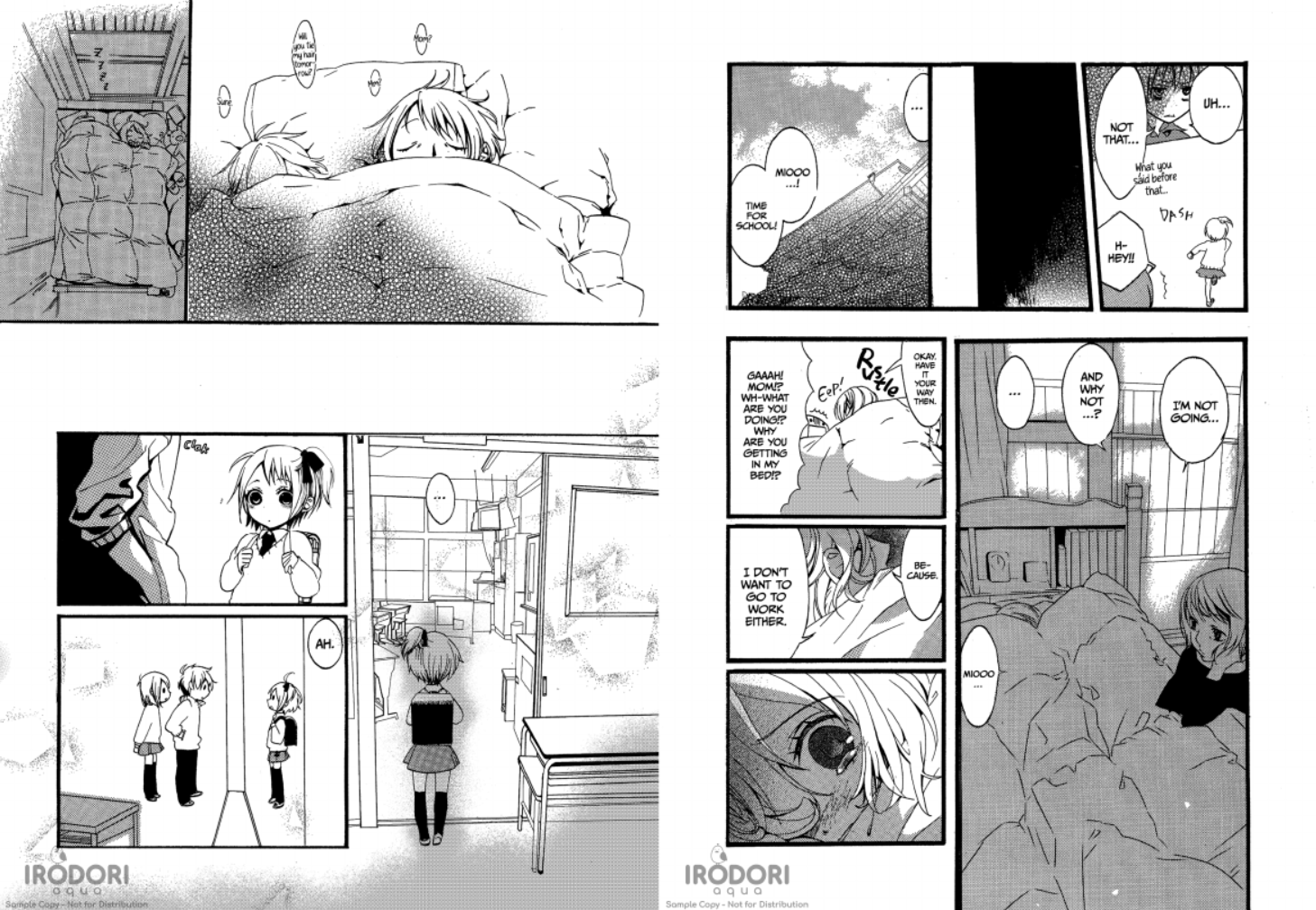
It’s thanks to her mother that Mio is able to come to terms with her condition, and continue to make friends, even if they may not spend more than a single year together. Frankly, I’d never thought about this type of situation, with the perception of time locked to your physical growth and maturity. I think that the fact Uta-sensei was able to explore this thanks to Mio being a human, as opposed to a fantasy race like an elf, meant that we were able to see how any of us would realistically feel or react when placed into this situation. Everyone goes to school, everyone goes through puberty, and has some rebellious phase. Seeing Mio interact with her first love, the boy named Yo Asama, who became a teacher at the high school she enrolled into, is weird! But it’s a hypothetical that makes sense to explore! Students crushing on their teachers happen all the time in fiction or maybe even real life, but the added dimension of them previously meeting while being the same age is such a strange wrinkle in that relationship. They clearly still care for each other, but not necessarily in a romantic sense. Mio goes through more bullying because that inherently strange dynamic to their relationship putting off other girls who had a crush on their younger (comparatively) teacher. After Mio suffers from the loss of her mother, she sees Yo again at the funeral. He comforts her by showing her that being a Leaper means that she can take the memories of those she cares about further with herself into the future, so that their lives can live on longer with her. It’s a beautiful statement that echoes the idea that “only the forgotten are truly dead.” Yo stood out to Mio in her blurry childhood because he was infatuated with space and rockets. Because she can live much longer than he can, she can also live to see his dream come true through herself. It’s poetic and shows their relationship has transcended the passage of time itself.
That dream does in fact come true in the last act. At biological age 25 (actual age 100), Mio becomes the first Leaper to become a space pilot. There’s a dream sequence that begins after she turns to see the moon, its light reflecting directly onto her. After she says there’s someone who would have loved to see it, someone teases by assuming it’s an ex-boyfriend. Holding her hand is a young Yo, from his kindergarten years, blushing and awestruck by the sight, and exuberantly shouting words that are blurred out. Mio says “No… thank you.” Her back profile is juxtaposed against the sight of Earth, while thinking: “He took the form of a kindergartner, born from memories of a time we shared alone… Memories that glimmer like a star in the darkness… shining its light upon me and giving me life.” The experiences she had as a child were what ultimately gave her the motivation and hope to continue living her life, regardless of the hardships she had to face as a Leaper, on top of the unavoidable consequences of time moving forward.
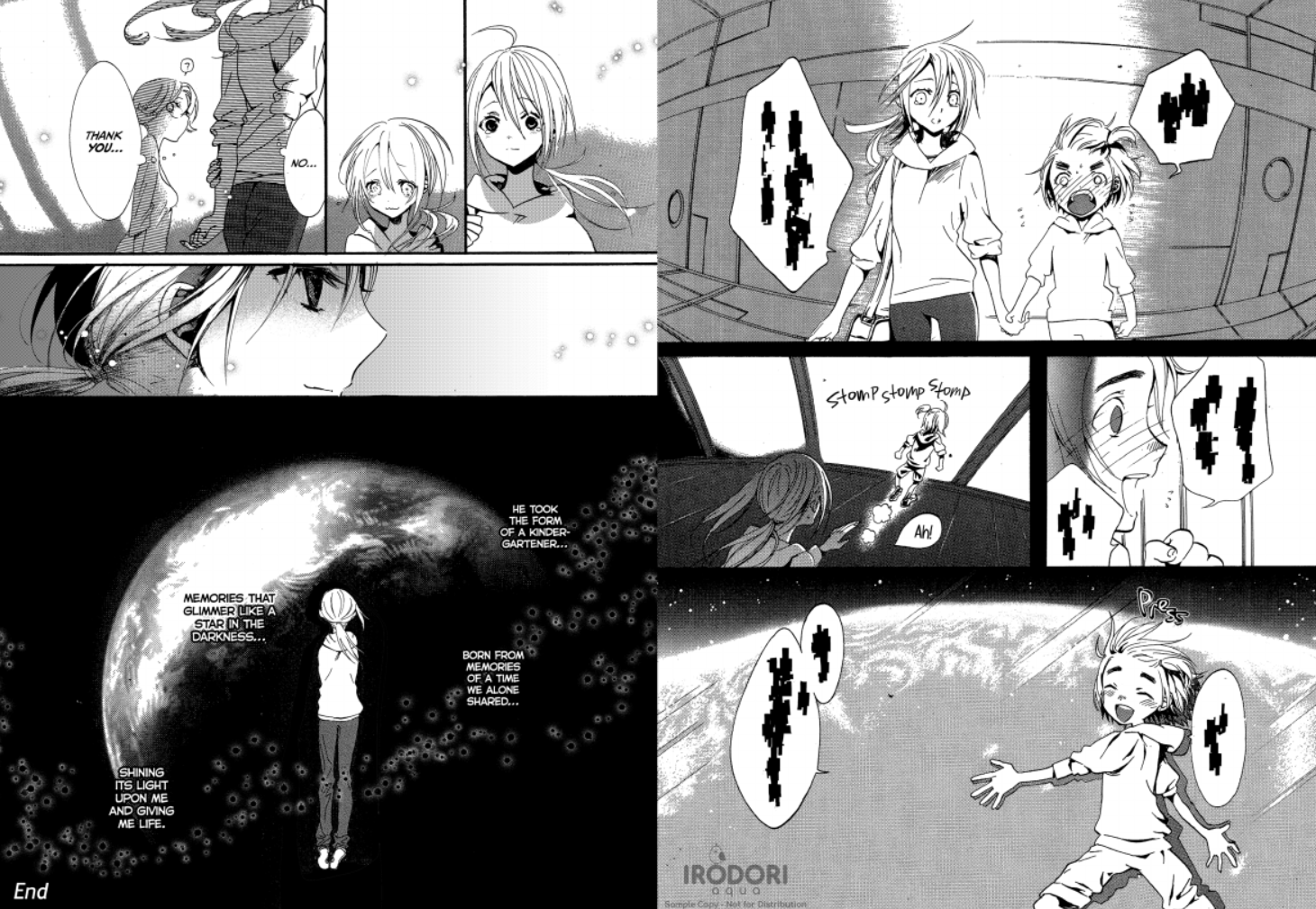
Now, I am not fond of outright recapping events when I review things! But I was so moved by these last few pages that I had to do my best to actually try and transcribe what I saw and why it made me feel the way it did. At its heart, Leaper is about learning to accept and love yourself. Mio always felt singled out because of her condition, and it was for that reason that her mother didn’t want to give birth to her that day. But even after it happened, Mio’s mother already knew and accepted the value of her daughter having her own life. That’s what leads to the comforting moment in the bed together after deciding to be truant for the day. And that same tenderness is what Mio is reminded of when Yo comforts her at her mother’s funeral. Remembering Yo’s young and excited countenance after finally achieving what he could not, there’s a deep sense of empathy and gratitude from Mio, for Yo being able to share that love of life with her. It’s something that she would never be able to experience without the help of everyone in her life who reached out to her in order to make her feel accepted. There are many stories of characters learning self-acceptance and actualization by themselves, but it’s equally important to acknowledge that many people out there, feeling beaten and trapped by their circumstances, also need a push and a hug from someone else in order to discover their own sense of worth. It’s special and poignant to see Mio’s self-actualization coming many years after that. The journey itself can many times end up making the destination worth traveling to.
There are still lots of things that I enjoy besides the writing here. Uta-sensei has a gratuitous use of screen tones that don’t actually suffocate the page. Many times, it’s used to stage lighting and and panel composition in a way that leads the readers eyes in a comfortable way.
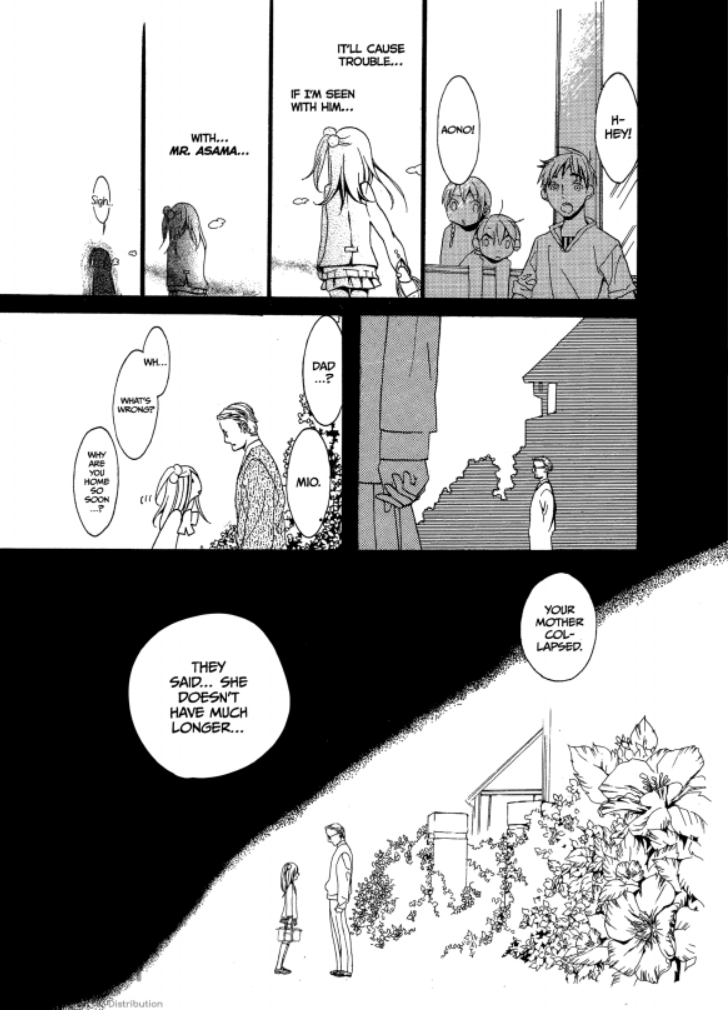
In the above page, scenes are sectioned off into three parts. The first part starts with people facing Mio, being grayed out. Mio’s internal thoughts are splayed over white background, as her body continually gets smaller and shaded in darkness, showing her emotional state as distressed and closed off. The second part gives us perspective from behind Mio as she approaches her home and sees her father against the grayed out silhouette of their house. She approaches him while asking why he’s home early. Keep in mind that both parts 1 and 2 have a theme of diagonal composition, with narrative tension rising as the visual space in the panels get shrunken down against the white backgrounds inside the panel. Outside the panels, we have deep black ink providing an ominous atmosphere and the impression that this is either a flashback, or that these events happened within a dark mental space. The final section has the last diagonal silhouette with all of the former white space now becoming blacked out, as there are no more panels, and the looming darkness has finally surrounded Mio with the revelation that her mother is close to dying. It’s very simple, but powerful composition. In animation and even live action film, “Dutch angles,” or shots with angled tilts from the camera’s perspective, are often used to disorient viewers and imply an off-kilter or confused headspace. The use of negative space on a comic page to recreate that same feeling of disorientation a film can give with a Dutch angle is very intuitive, maybe even genius! It shows that Uta-sensei has an astounding sense for composition, even before becoming a professionally serialized artist. I’ll also say that besides that knack for composition and use of tones, I’m also a huge fan of the use of flowers and plants for introductory panels that show the next step in Mio’s life–it gives a distinctly shoujo manga feel that I appreciate.
I am extremely satisfied with Leaper, if it wasn’t clear by now. If I had to give it a rating out of 5, I think I would actually give it a full 5/5. I enjoyed this equally as much as Mermaid in the Bottle, for very similar reasons. It’s a unique story that I feel can be enjoyed by many different kinds of people. Being able to discover this artist’s work has been nothing but a blessing, because twice now, I’ve been floored with how they were able to use the medium that comics provide to pen and illustrate such vibrant and emotionally rich stories. This is what makes doujinshi worth your investment as a reader and supporter.
Leaper, by Isaki Uta, was published today–February 28th, 2021! (if only this was last year, we could have gotten it on an actual leap year!)–by Irodori Comics under their Irodori Aqua label. It was localized and translated with close collaboration with the author, who gave their final approval before becoming available for sale. The actual localization work itself is also phenomenal! If you scroll back up and look at the page with the panel of Mio facing the Earth, a part of her monologue is directly over its dark side, un-enveloped by light. The letterer makes a very simple but effective choice to place words there that are written in white font with black borders, rather than black font with white borders, in order to make it readable. It’s very subtle, and does not at all detract from the art, much like the rest of the comic itself. Similarly, the translation reads very naturally to me as a native English speaker. So thank you Ed Ayes and Tim Sun, and your editors/QA staff for making sure we got the best from you! For anyone interested in purchasing Leaper, it’s available on Irodori Comics’ website! It’s about 50 pages for $5.45 USD. For those unaware, doujinshi, being self published and self-made, are created without the help of editorial staff or assistants, and the price also reflects that. Do be aware that at least 50% of the sales go directly to the author, as Irodori directly collaborates and licenses from their doujinshi authors! It’s a great option to support great artists in an official capacity.
*This review was possible thanks to Irodori Comics for providing a free review copy!
 Culture, the Wavey type