
Why This Exists
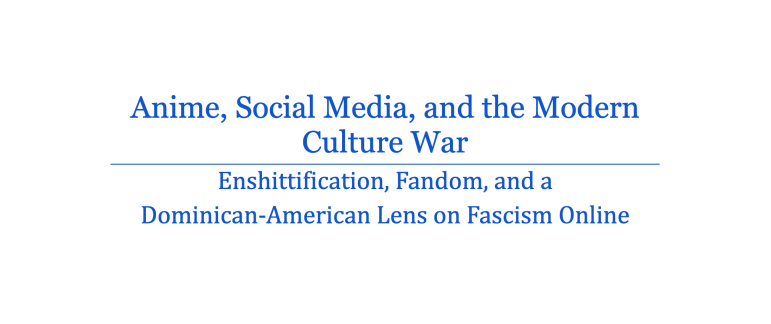
I wrote a free PDF titled Anime, Social Media, and the Modern Culture War because I kept noticing the same arguments repeating online and felt like I was missing the map. Whether the topic was anime, “wokeness,” nationalism, free speech, or platform drama, the conversations kept collapsing into the same cycles of outrage, confusion, and exhaustion.
You can download the full report as a PDF below.
This started as a personal research project. I was reading journalism, academic work, platform policy analysis, and media criticism side by side, trying to understand why fandom spaces and political discourse feel so entangled now—and why social media seems to make everything sharper, louder, and harder to think through. Eventually, the pattern clicked: these dynamics aren’t just about ideology. They’re about infrastructure.
The core argument here is simple. Social media platforms don’t invent the culture war, but they intensify, organize, and monetize it. Algorithmic feeds, engagement incentives, memes, and short-form video reshape how conflict shows up, especially in fandom spaces where people are already emotionally invested. Anime and “Cool Japan” aren’t the cause of this; they’re flexible symbols that get pulled into it—sometimes for connection, sometimes for projection, sometimes for exclusion.
This isn’t a manifesto or a hot take. It’s a synthesis. The document is dense on purpose, because I wanted to trace mechanisms rather than argue a single political line. My perspective as a Dominican-American cultural journalist shapes the framing, but the goal isn’t persuasion. It’s clarity: making the scaffolding visible, and offering readers tools to think more deliberately inside increasingly enshittified platforms.
I’m sharing this publicly, for free, because it’s built on public research, shared culture, and open debate. If it’s useful as a reference, a teaching aid, or something to think alongside, that’s enough. You don’t have to agree with every framing choice. I only ask that it be read slowly, critically, and with attention to the systems it’s describing.
 Culture, the Wavey type