Why manga is the original text behind anime adaptations.
There’s a version of me that never read manga.
He grew up glued to KidsWB on Saturday mornings, racing home to catch Toonami, flipping to whatever Dominican channel was running Jetix or AniMax or Pokemon dubbed into Spanish.
Anime was the air.
DBZ power levels were serious academic discourse.
This was not a phase. This was formation.
That formation had architects. My cousins Ismael and Elvis were raised with me like siblings. Ismael was the oldest, and tech-savviest: hosting IRC calls, going to LAN parties, pulling Naruto episodes over LimeWire before Toonami even got to them. He handed us the culture before the culture was officially available to us.
We kept up with the Big 3 of Weekly Shonen Jump through various eras of “mainstream” pirate sites (onemanga, mangafox, mangapanda, etc), reading on whatever screen we had. I learned the rhythms of Weekly Shonen Jump, then Magazine, then Sunday, and even further beyond. Bodega copies of VIZ’s print WSJ. Scholastic book fair and Borders pickups.VHS tapes and DVDs from Blockbuster after birthday money. Library rentals when the budget ran out. Whatever we could get.
I was already reading manga. I just didn’t fully understand yet what I was holding.
Then Tokyo Ghoul’s anime ended—and for the first time, I was ahead of my cousins.
Ismael had gotten us in. But somewhere in those weekly chapter threads that ran 1,000+ pages deep, I had outrun him. I knew what happened before he did. The people who formed my taste were now waiting on me. Something had shifted. I understood then that I wasn’t just consuming anymore; I was tracking a living story in real time, in community with strangers across the world who cared as much as I did.
That doesn’t happen with anime on someone else’s release schedule. That’s a manga reader’s experience.
Here’s something I don’t think gets said enough in these conversations:
Anime is a translation.
Anime Is a Translation of Manga
Not metaphorically. Functionally. A studio, a production committee, directors, animators, schedulers, episode count negotiations, and broadcast standards all stand between you and the story a mangaka made. That’s not a criticism! Translation is a craft, and great anime is genuinely great art! But most anime are adaptations of manga, meaning the animated version is one interpretation of the original text.
I know this intimately, because I’m a translator.
I interpret Spanish for my family daily: handling calls, paperwork, conversations they can’t navigate alone in English. Before Covid, I interpreted Japanese and English for the chefs and customers at an omakase sushi restaurant. I understand what it means to carry someone’s meaning across a language barrier and how much gets weighed, chosen, left behind. No translation is neutral. Every translation is a set of decisions made by someone else on your behalf.
You see, when I got to high school and saw Japanese on the course list, something clicked. I was already reading translated manga every day. I was already living inside someone else’s interpretive choices. What if I just… learned the language?
I did. Out of pure love for the medium.
And it changed everything; not just what I could read, but how I understood what I’d already been reading. The difference between what a character says in Japanese and what survives localization. The cultural weight of an honorific that disappears in English. The way certain mangaka use sound effects as visual texture, not just noise. You start to see the seams of every translation you’ve ever loved, and you love them differently for it.
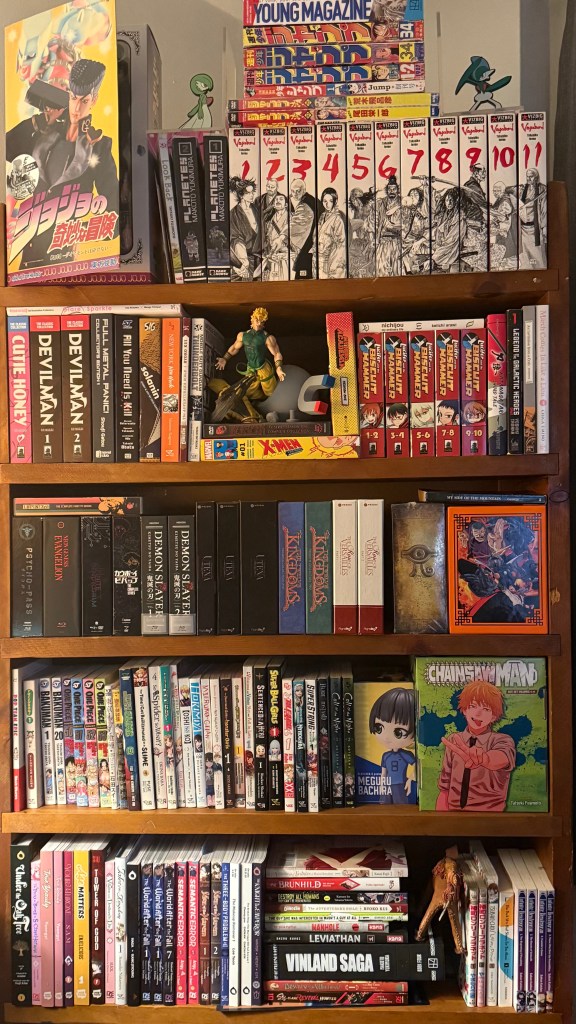
I went from anime-only kid watching Saint Seiya in Spanish on Dominican TV to reading every corner of manga’s spectrum from 花ゆめ to モーニング to ガンガン in its source language. Shonen, Shojo, Josei, Seinen, whatever Harta was running that month. Not because I was trying to be impressive. Because manga is that good. Because the stories pulled me that far in.
You don’t have to learn Japanese. That’s not the ask.
The ask is simpler: if your favorite story started as a manga, you’ve only ever seen one possible version of it. One adaptation. One committee’s interpretation. And in too many cases (Promised Neverland, Bleach’s filler years, One Punch Man, among others) that adaptation made choices the source material didn’t. Sometimes they hurt.
The manga doesn’t go through that. No “filler.” No production delays warping the pacing. No episode count forcing a rushed ending. One artist’s vision, often one person writing and drawing, panel by panel, at whatever pace the story demands. You read it when you want. You sit with a page as long as it asks you to.
And there are hundreds of finished stories waiting for you—officially licensed, in English, available cheap or free through Manga Plus, Omoi, your library’s Hoopla or Libby access, or a collected volume that costs less than a streaming subscription.
This isn’t anime vs. manga. I love both. I grew up on both; just in different languages, on different continents’ worth of programming.
This is about coexistence and completeness. Anime brought most of us here. It’s a powerful, legitimate, beautiful art form. But it is, at its core, a translation device for stories that often began somewhere else.
If you’ve only ever watched, then you’re working with a translation of a translation.
The original text is right there.
And if you’re lucky, picking it up will feel like discovering something you already love for the very first time.
That’s how manga gets you. That’s how it got me.
Wavey writes essays about manga, anime, and pop culture at Wavey Culture.
 Culture, the Wavey type