A Culture Hub Review, By Michael “Wavey” Peña
Spoilers ahead for One Piece, both Netflix’s Season 2 and up to the current manga arc.
Why Netflix’s One Piece Live Action Season 2 Is the Soul-Healing Sequel We Needed
If Season 1 of Netflix’s One Piece was a tentative dip into treacherous waters, testing whether modern audiences were still too irony-poisoned from the past decade to accept a rubber man in a straw hat, then Season 2 is a full-speed plunge into the deep end of sincere emotion. Much like the goodwill WIT Studio maintained during the gap between early seasons of Attack on Titan, the team behind OPLA has returned from a strike-induced hiatus with a sequel that feels like a homecoming.
As a cultural journalist who has followed Luffy’s journey since childhood, I find this adaptation’s commitment to unapologetic heart sincerely moving. It reminds me of the labor struggles I’ve seen in my own life even recently: the NYSNA nurses’ union strikes at my day job lasting six weeks just to get fair contracts this past January. Seeing this production recover from the SAG-AFTRA strike to deliver something this polished is a victory for collective vision.
Brothers by Combat
One of Season 2’s greatest strengths is how the showrunners, with Oda’s direct oversight, leverage the fact that the manga is still serialized to make the world feel lived-in and cohesive. The expanded conversation between Michael Dorman’s Roger and Vincent Regan’s Garp in the premiere does wonders for Garp’s PR, reframing their rivalry through the lens of legendary bouts where they became closer than mates. The show boldly references God Valley and features Sabo (officially confirmed!) and Nahum Hughes’s Bartolomeo in full costume earlier than anyone expected!
Here’s what makes the ASL (Ace, Sabo, Luffy) brotherhood work where it could easily have tripped into “Battle Shonen Jesus” destiny tropes à la Naruto or Bleach: it’s rooted in personality, not prophecy (at least for now). It is because Roger and Garp became brothers over their clashes that Ace and Luffy were able to be raised together as actual brothers. It makes complete sense that Garp would see Roger’s son as his nephew. Combat made them brothers, and brotherhood made Garp a father to a boy who wasn’t his. That dynamic has consequences I explore at length in a companion essay—but for the review, what matters is this: legacy doesn’t flow through bloodlines in One Piece. It flows through the people who showed up, fought beside you, and then chose to raise whoever came next.
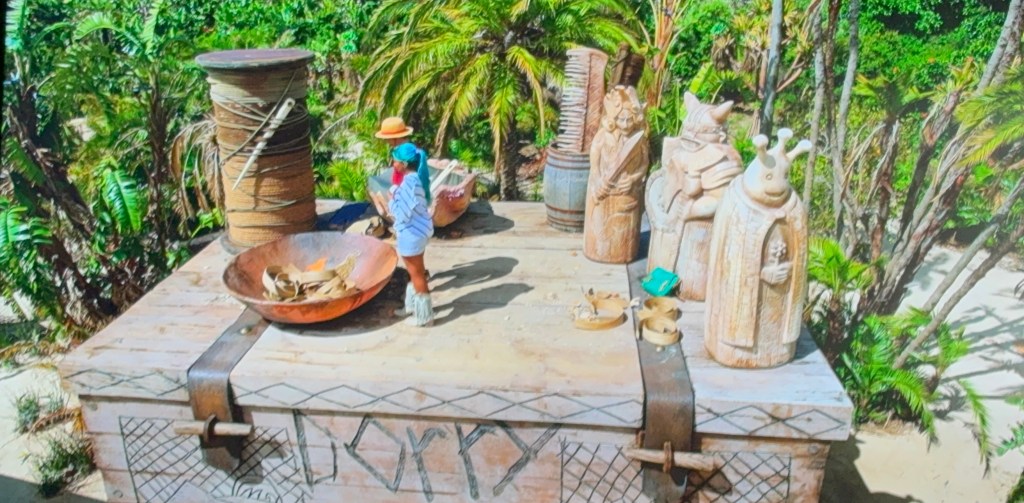
Little Garden’s giant-scale set design hints at the mythic weight the season brings to Dorry and Brogy’s duel.
This pattern repeats across the season. Brendan Murray’s Brogy and Werner Coetser’s Dorry carry a century-long duel on Little Garden with mythic sincerity. Iñaki Godoy’s Luffy and Jacob Romero Gibson’s Usopp watch them clash like it’s UFC: kino, tokusatsu, the romance of shonen rivalry! Even the execution platform at Loguetown rhymes with it. Luffy declares he’ll find the One Piece with Jeff Ward’s Buggy as his witness, a man raised by Roger the way Garp raised Luffy.
Luffy the Liberator
I’ve often written about Luffy’s pursuit of personal freedom, but Season 2 pivots toward his role as a liberator. While Luffy may not consciously aim to be a hero, his presence inherently dismantles oppression. Not through ideology, but through sincerity.
We see this most clearly in the Nika dance he performs to Binks’ Brew! More than just a dance; it’s an invitation to joy that requires dropping your guard entirely. And manga readers watching this scene carry additional weight: in the current Elbaf arc, Oda has revealed that the Giants’ entire spiritual culture revolves around Sun God Nika. Elbaf’s ancient religious text, the Harley, contains competing interpretations of Nika as either a liberator and God of Laughter or a destroyer and God of ruin. The giants hold a Winter Solstice ceremony, a twelve-day fast paying gratitude to the sun. So when the live action stages Dorry and Brogy’s duel with that sincere mythic reverence, and then gives us Luffy doing the Nika dance at Reverse Mountain, it’s not just fan service. It’s the show unknowingly (or knowingly, given Oda’s oversight) laying the cultural groundwork for the giants’ theology. Luffy is dancing as the god these warriors already worship, and he doesn’t even know it.
Godoy’s performance captures the liberator thread through quieter moments too. Luffy talking to Laboon at eye level. Validating Chopper’s existence as a “monster”: “Isn’t it great?” Hanging up Hiruluk’s Jolly Roger, saying he respects all pirate flags. Whether it’s a whale, a reindeer, or a dead man’s dream, his magnetism comes from seeing the dignity in everyone.
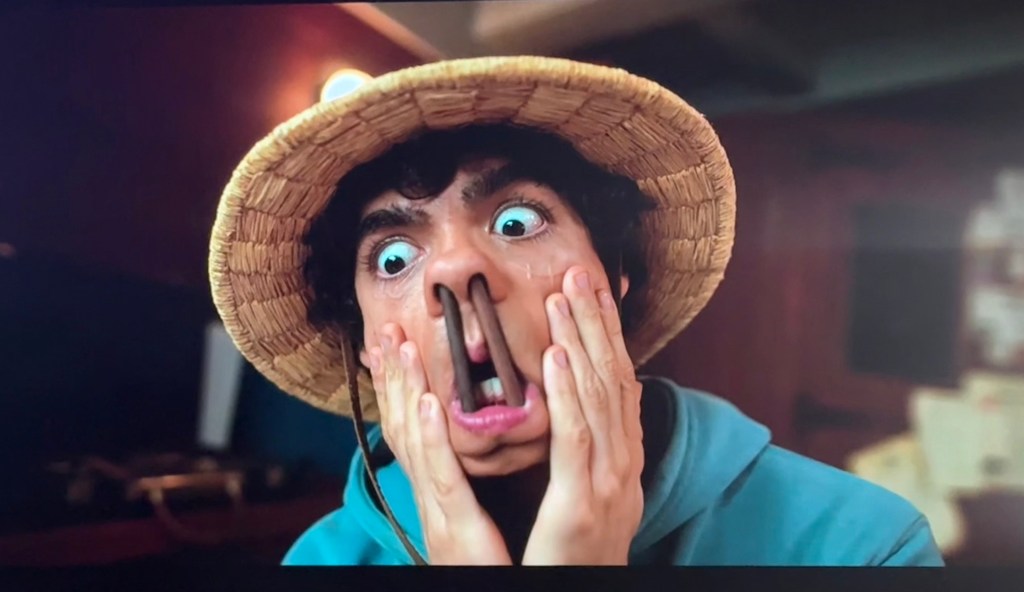
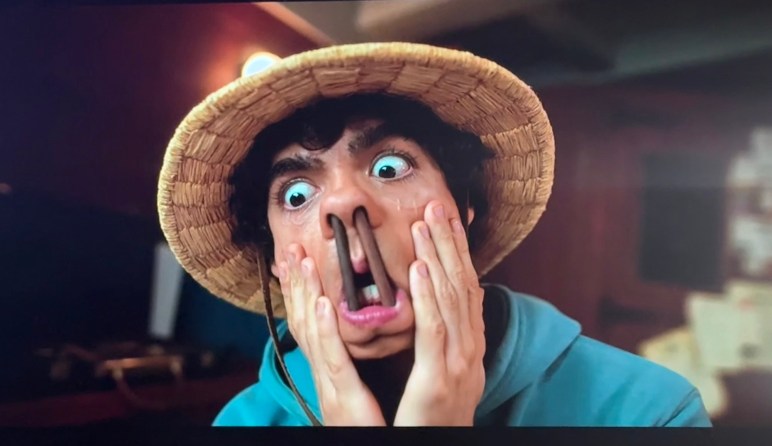
Liberation, Luffy-style.
The Loguetown execution sequence crystallizes it. Getting struck by lightning after accepting his incoming death with a laugh—“Lucky Me!”—was legendary! Smoker names the threat plainly: he “laughed while staring death in the face. That is what we’re fighting against.” And Mark Harelik’s Hiruluk, three arcs later, dies with that same smile. These aren’t separate moments. They are refrains of the same song.
Charithra Chandran’s Vivi also teaches Luffy something crucial for leaders: humility for the sake of the people he’s responsible for. Luffy learns from Vivi how to stand by people, not just fight for them.
From “Toxic Yuri” to Ride or Die
The subtext between Emily Rudd’s Nami and Chandran’s Vivi is a masterclass in high-EQ character writing, evolving from deliberately tense energy to a profound bond. Their early interactions are charged: trash-talking, flustered deflection, escalating intensity. Vivi winks “bye bye baby.” Nami stares gayer. The show knows exactly what it’s doing.
The shift happens at Whisky Peak. When Vivi watches Yonda Thomas’s Igaram die before her eyes, Nami immediately soothes her, recognizing the exact pain of losing a parental figure because she lived through Bellemere’s execution. Emotional intelligence forged in grief. By the time Nami is holding Vivi on the way back to the ship after Little Garden, the “toxic” edge has softened into genuine crew loyalty. Vivi agreeing to prioritize Nami’s health over reaching Alabasta, considering how they started, is one of the season’s quietest, most significant beats. By the finale, everyone considers Vivi one of the Straw Hats. She earned it.
C*nty Fruitcake, but Make it Cinema
The production value has evolved to where practical and digital effects blend with a finesse that puts other anime adaptations to shame, and nowhere does this show more confidence than in its ensemble.
Ward’s Buggy is Heath Ledger’s Joker and I am living for it! David Dastmalchian’s Mr. 3 is an insanely cunty, flaming fruitcake who manages to be genuinely threatening while giving Buggy a run for his money. I’m practically salivating for Impel Down… Rob Colletti’s Wapol is channeling Jack Black’s Bowser: hammy, grotesque, effective. His mutated soldiers are the stuff of body horror, and the season’s costume, makeup, and 3DCG integration have been consistently excellent.
Gibson’s Usopp looks remarkably like Bad Era Michael Jackson from the eyes to the lips, bringing a visual pop that fits the character’s renewed arc. This is the Usopp arc Season 1 was missing: Brogy as catalyst, the 1v2 at Little Garden as the brave warrior moment, motivating Luffy when he’s deflated. Everything earns its payoff. The Flame Star into a Flaming Sword Slash combo with Mackenyu’s Zoro? Absolute Cinema.
Daniel Lasker’s Mr. 9 pulls a last-second badass turn! Camrus Johnson’s Mr. 5 and Jazzara Jaslyn’s Ms. Valentine are credible physical threats. Sophia Anne Caruso’s Miss Goldenweek has a whole vibe. Lera Abova’s Miss All Sunday radiates enigmatic authority. Thomas’s Igaram jams on a saxophone and makes espionage feel like jazz. James Hiroyuki Liao’s Ipponmatsu brings the hammy sword shop energy the source material demands. Hughes’s Bartolomeo works as an anti-paparazzi bodyguard with pure fanboy devotion! Clive Russell’s Crocus carries quiet paternal warmth in passing Nami a Log Pose that may have been Roger’s own. Taz Skylar’s Sanji reminiscing about his mom is quietly overwriting lots of manga Sanji’s accumulated bad PR. Mikaela Hoover’s voice and motion-capture work for Chopper brings genuine vulnerability to a character who could easily have been just boiled down to cute.
And the show revels in Oda’s absurdity with total nonchalance! You’d be hard-pressed to find another series that features a pajama-wearing otter riding a machine-gun-mounted vulture and portrays it with a matter-of-factness that says “canniness be damned.”
Callum Kerr’s Smoker deserves special mention. First distinctly American energy in the cast. Looks like a Terminator, built like a Navy SEAL, but so kind to a little girl that watching Julia Rehwald’s Tashigi be clumsy around him evokes the same fatherly warmth as Garp. There’s a logic to his physicality: brick-hard in base form, the softness of his Logia transformation lands that much more powerfully, making for devastating propulsion and bludgeoning. Dragon’s Devil Fruit is to Smoker’s what Akainu’s is to Ace and Sabo’s—elemental counterparts across the moral divide. He is the standard.
A Man Dies When He Is Forgotten
The Drum Island arc across the final three episodes is the emotional core of the season.
Harelik’s Hiruluk is desperately trying to save people, even if he’s untalented at it. He’s trying to be noble. He discovers an injured Chopper and earns his trust through the most vulnerable act possible. Chopper has the most important qualification of being a doctor: a big heart. Hiruluk may die, but his dream lives on. He chooses to die smiling, remembering his son. And when Chopper stands up to Wapol to heal the people who called him a monster—because that’s what a doctor does—Hiruluk’s will is alive in every diagnosis.
Ty Keogh’s Dalton echoes the question to Katey Sagal’s Kureha: “When does a man die?” She snaps back: “The country is sick!” Vivi stands up to Wapol with a speech about leadership. Baroque Works is inciting rebellion in countries that don’t need them. The crew is learning that their compassion has political weight.
Sagal’s Kureha has incredible vocal mastery; it sounds like professional voice acting, every line calibrated. The direction on Drum Island captures the magic of the source material: the moonlit sled ride down the wire, and then the image that defines the season—Chopper crying at the cherry blossoms while Zoro carries him on his shoulder! Hiruluk’s dream made visible.
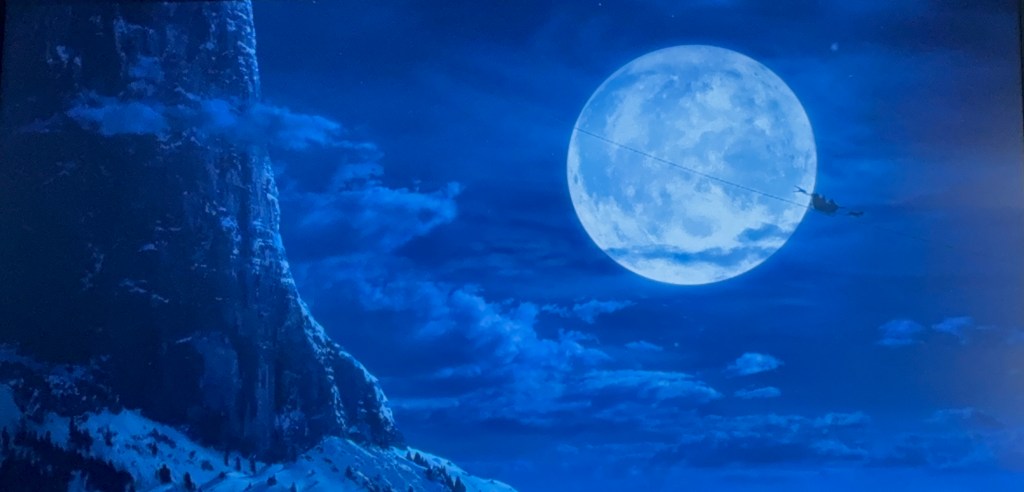
Hiruluk’s dream, carried down the mountain in a one deer open sleigh.
And then Luffy hangs Hiruluk’s Jolly Roger. Not his own flag. A dead man’s flag, raised by someone who recognized what it stood for. There’s a deeper argument to be made here about how every Jolly Roger this season functions as a creed, how those creeds trace back to which parent raised you and what they were willing to sacrifice, and how the season’s moral divide comes down to a single question about vulnerability. I’m making that argument in full next week in a piece called “Flags and Fathers.” But the short version: the flag you fly is the parent you had.
Lucky Us: Good Faith as the Creed Worth Carrying
One Piece Season 2 is a miracle of alignment between director’s vision and author’s intent. The production value, scripts, and ensemble performances represent a genuine leap from Season 1.
But what makes this season stick isn’t the spectacle. It’s that every relationship follows the same quiet blueprint: someone who didn’t have to care for you chose to, and what they taught you became the flag you carry. Koby said it back in Season 1: there are good folks and bad folks. Season 2 shows you what makes the difference.
And I mean “good faith” in both senses. Within the story, the faith of good people is the creed that gets inherited by the next generation. Garp’s faith in Roger’s son. Hiruluk’s faith in a reindeer no one else would touch. Bellemere’s faith that her daughters were worth dying for. That faith, passed down through vulnerability and sacrifice, is what makes the Straw Hats who they are.
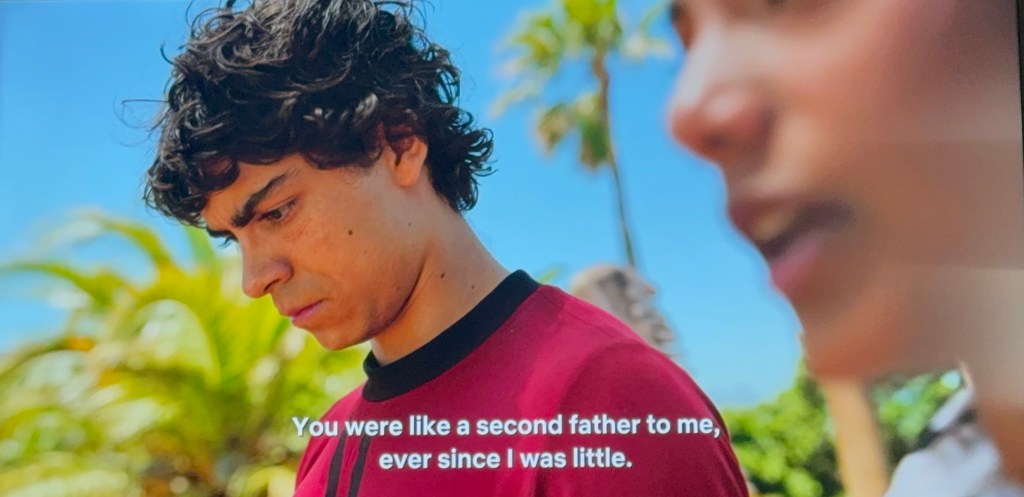
The creed underneath the season, said out loud.
But “good faith” also describes the production itself: this adaptation keeps faith with Oda’s manga in a way that feels less like translation and more like inheritance. The showrunners aren’t just adapting the plot. They’re carrying the spirit. The sincerity, the absurdity, the willingness to be earnest in a cynical era—that’s Oda’s creed, and this team has inherited it with the same devotion Chopper inherits Hiruluk’s dream. The meaning and intent of the source material arrive intact, not because the adaptation is literal, but because the people making it believe in what the story is actually about.
In the world we’re living in right now, that distinction matters more than any Devil Fruit power.
More on that next week. For now: if they maintain this trajectory into Alabasta, the live action isn’t just a good adaptation. It’s becoming its own essential version of the story.
 Culture, the Wavey type