A companion essay to “Good Faith on the Grand Line: OPLA Season 2 [REVIEW]”, by Michael “Wavey” Peña. Spoilers for One Piece Season 2 (Netflix) and the current manga arc.
If you’ve been reading One Piece long enough, you know that “inherited will” isn’t just a theme. It’s the engine. It’s why Roger smiles at his execution. It’s why Luffy wears the hat. It’s why the story insists, over and over, that a man doesn’t die when his body fails. He dies when he’s forgotten. Oda has been threading this idea through nearly thirty years of serialization, and if you’re current with the Elbaf arc, you know it’s only getting more explicit: the giants’ theology, the Harley, the competing interpretations of Nika, the argument over whether the Sun God is a savior or a destroyer. Inherited will is the spine of the entire story.
What Netflix’s live action Season 2 does, beautifully, is take that spine and make it specific. Not inherited will as a grand mythic abstraction, but inherited will as something intimate: who raised you, what they sacrificed, and whether the creed they passed down taught you that vulnerability is the beginning of connection or the beginning of defeat.
I wrote last week about the season’s sincerity, its production, its cast, and the way the Nika dance at Reverse Mountain unknowingly lays groundwork for Elbaf’s theology. But there’s a structural argument underneath all of that which I didn’t have room to make. Every Jolly Roger this season is a creed. Every creed was written by a parent. And the entire moral divide of the season comes down to a single question about what those parents were willing to give up.
What You Die Under
Start with the flags themselves. Each arc this season centers on a different Jolly Roger, and each one represents a different philosophy of death and legacy. The Rumbar Pirates’ flag is a promise to return that outlives its crew. Igaram’s disguise conceals a man willing to die for his charge. Dorry and Brogy fly a flag that presides over a century of honorable combat. Mr. 3’s candle-wax insignia belongs to a man who wants to be remembered by history but won’t sacrifice anything real to earn it. Hiruluk’s flag, adorned with cherry blossoms, says a man dies when he is forgotten. And Wapol’s flag represents a kingdom that consumed its own people.
These aren’t just production design choices. They’re value systems. The season is structured as a procession of creeds, each one asking the same question: what are you willing to die for, and did you learn the answer from someone who loved you?
Manga readers will recognize this structure immediately. Oda has always used pirate flags as declarations of philosophy, from Luffy punching through Arlong’s flag to Whitebeard’s flag being the shield that protects his family. What the live action does is compress that idea into eight episodes where the flags function almost like church banners: each one hung over an arc that tests what the creed actually means when the people carrying it are under pressure.
Parenthood Without Blood
Now trace who raised whom.
A marine raised a pirate’s son as his nephew, because combat forged them into brothers and brotherhood made him a father. A failing doctor, untalented and dying, raised a child no one else would touch by stripping himself bare in the cold to prove he was safe. A mother raised two girls who weren’t hers and died so they could live, and that sacrifice taught her daughter how to hold someone in the exact moment their world breaks. A lighthouse keeper passed down an instrument of navigation not because it was earned by rank, but because he recognized what the recipient carried. A captain parents his subordinate with gruff tenderness inherited from the generation above him. Two giant warriors, without trying, parent a young pirate’s bravery into existence just by letting him witness what honor costs.
None of these parents share blood with the children they raise. That’s the point. In One Piece, parenthood is a choice, and the choice is always costly. It requires making yourself smaller, softer, or more exposed than you’d naturally be. The doctor undresses in the freezing cold. The captain climbs a mountain barehanded. The mother takes a bullet. Parenthood in this world is synonymous with vulnerability. You give something up to prove you’re safe, and what you give up becomes the creed your child carries forward.
What the live action clarifies, even more sharply than the manga sometimes does in these early arcs, is that the children don’t have to relive the suffering to carry the creed. Chopper becomes a doctor in a world Hiruluk couldn’t survive. Nami navigates the Grand Line with tools and confidence Bellemere never had. Luffy inherits Shanks’s bet and Roger’s will without having lived through either of their eras. The inherited creed doesn’t require you to endure what your parents endured. It requires you to understand what it cost them, and to make the conscious choice to carry it forward anyway.
The Flag Without the Cost
And then there are the characters who refuse to pay that price. Wapol doesn’t raise his people; he eats them. Baroque Works doesn’t mentor its agents; it numbers them and sends them to die. Mr. 3 wants legacy without sacrifice. Every antagonist this season represents the refusal to be vulnerable on behalf of someone else. They want the flag without the cost.
The contrast is structural, not just moral. The season’s heroes all learned vulnerability from someone who modeled it. The villains either never had that model or rejected it. The difference between the two sides isn’t power or even intention. It’s whether you were taught that letting your guard down is the beginning of connection or the beginning of defeat.
What Grows in Soil You Didn’t Plant
I need to get personal here, because this isn’t just a reading of a Netflix show to me. It’s a reading of something I’ve lived.
My grandmother, Luz Peña Pimentel, raised her family in Baní, Peravia, in the Dominican Republic. She was the most talented green thumb in her village. She grew every variety of fruit the province exported, and she taught me that closeness to nature, including farming, is incredibly grounding. When I say “touch grass,” I mean it with her hands in the soil behind those words.
She told me something once, when I was young, that made me angry for years: “Tú no eres Dominicano.”
I carried that sentence like a wound through college, her passing, and into my twenties; turning it over, resenting it, not knowing what to do with a creed that felt like rejection. It took me years of wading lost in my own feelings and desires to realize what she actually meant. She wasn’t rejecting my identity. She was telling me that I am not Dominican the way she was. I didn’t grow up entirely on that island, didn’t live through what her generation survived, didn’t navigate the same material conditions my mother did. Instead, I was raised with American public education, public healthcare, citizenship rights, and infrastructure that gave me a floor her generation never had. She was telling me: you are both. You are American and Dominican. And the values I’m giving you were forged in a place where the systems holding you up didn’t exist.
That’s inherited will. The creed arrives before you’re ready for it. You carry it for years without understanding it. And the moment you finally choose to believe what you were taught, not because you have to, but because you’ve lived enough to recognize its truth, that choice is what makes it yours.
Part of my Catholic upbringing was understanding creeds and inherited faith, but also the value of free will. Making the conscious choice to continue believing what you were taught is in itself a statement of what you learned and who you learned it from. It’s not passive inheritance. It’s active acceptance. That’s the difference between receiving a flag and choosing to fly it.
I see this everywhere in One Piece Season 2. Chopper doesn’t just inherit Hiruluk’s dream. He chooses to heal the people who called him a monster, because he’s decided that’s what a doctor does. Nami doesn’t just carry Bellemere’s trauma. She actively uses the emotional intelligence that grief taught her to hold Vivi in her worst moment. Luffy doesn’t just wear Shanks’s hat. He hangs up a dead man’s Jolly Roger because he recognizes what it stands for, even though he never met the man who flew it.
The creed doesn’t ask you to suffer the way your parents suffered. It asks you to honor what their suffering taught them by choosing to live it forward. Luz’s hands in the soil of Baní gave me the values I carry in New York. I compound medicine now with hands she trained to respect the work of cultivation: patience, precision, care for what sustains other people. Hiruluk’s death in the snow of Drum Island gave Chopper the creed he carries into every diagnosis. The flag you fly is the parent you had, but only if you choose to keep flying it.
Vulnerability as Seed
The vulnerability thread stitches the whole season together if you’re watching for it. But it’s more than connective tissue. It’s generative. Every time a character makes themselves vulnerable this season, something grows from it.
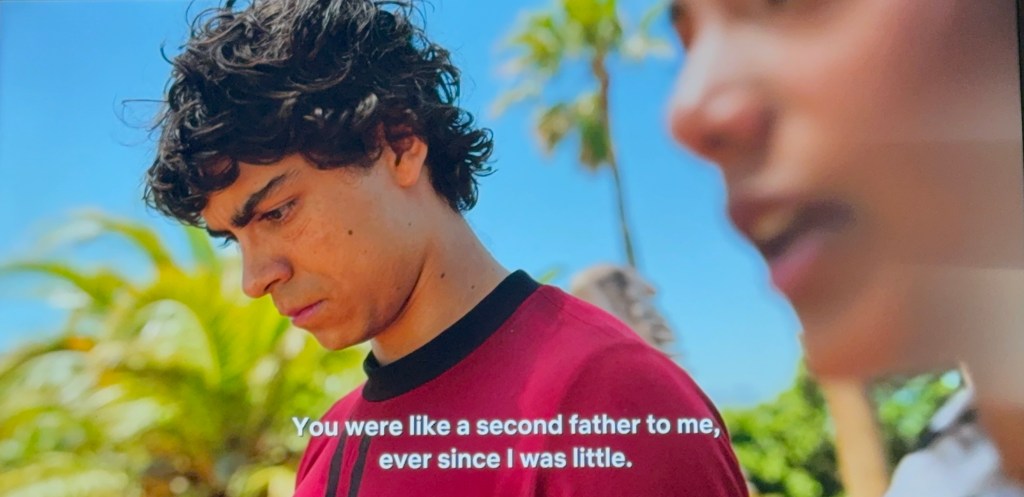
The fruit of parenthood without blood.
A man laughs on an execution platform, surrendering himself to death, and a stranger in the crowd falls in love with the courage it took. Three arcs later, a dying doctor mirrors that exact smile, and his son resolves to become a healer. A captain’s brick-hard body becomes soft smoke, and that softness is what makes him powerful. A boy ties a sick girl to his chest with his own coat and climbs with bare hands, and she gives him her full trust as captain. A pirate who would never cry in battle weeps openly while carrying a child on his shoulder through falling cherry blossoms, and the child knows he belongs.
Vulnerability isn’t just the price of connection in this season. It’s the seed. Every act of openness produces something in the person who witnesses it: trust, bravery, a doctor’s resolve, a navigator’s instinct, a fanboy’s devotion. The characters on the right side of this story’s moral divide all learned to be open from someone who was open first. The seed was planted in soil they didn’t choose, and what grew was the creed they carry.
Parents Are The Flag You Fly, But Your Sacrifices Reveal Your True Self
Koby and Luffy figured it out together in Season 1. Koby wanted to be a marine because he thought marines protect people. Luffy wanted to be a pirate because he thought freedom was worth chasing. What they taught each other was simpler than either expected: there are good folks and bad folks, and the uniform doesn’t tell you which is which. The bounty poster doesn’t tell you. The Jolly Roger doesn’t tell you. The crown doesn’t tell you. Only the sacrifice tells you.
It’s not strength. It’s not destiny. It’s who raised you, what they sacrificed, and whether the creed they handed down taught you that vulnerability is strength or that vulnerability is death.
Shanks gave Luffy his hat and taught him that a bet on someone’s potential is worth an arm. Garp, a marine, raised Roger’s pirate son because brotherhood made him a father, and that fatherhood gave Ace and Luffy a home. Hiruluk gave Chopper his smile and taught him that a big heart matters more than talent. Bellemere gave Nami the knowledge that love costs everything and is still worth it, and Nami carries that forward every time she holds someone through their worst moment. Crocus passed down Roger’s Log Pose to a navigator he’d just met, because he recognized what she carried. Smoker parents Tashigi with the same gruff tenderness Garp’s Marine Code modeled. Dorry and Brogy parent Usopp’s bravery into existence just by letting him witness what honor costs.
Wapol gave his people nothing—and consumed them.
The flag you fly is the parent you had. And Luffy, the boy raised by a marine who loved a pirate, keeps choosing to raise flags that aren’t his own for people who never asked, because that’s what was modeled for him.
Someone’s Chopper, Someone’s Nami
That’s the creed underneath One Piece Season 2. It never says it out loud. It doesn’t have to. Every flag tells you.
But I want to take it one step further, because this pattern doesn’t stop at the edge of the screen.
One Piece has always found its most passionate audiences among people who understand, firsthand, what it means to resist systems that dehumanize you. The story’s insistence that liberation starts with seeing someone’s dignity isn’t abstract to communities fighting for their rights in the real world. The Straw Hats’ refusal to look away from suffering, their willingness to be vulnerable in the face of power, their insistence on treating strangers with the same sincerity they’d give their closest crew: these aren’t just anime tropes. They’re the same values that sustain people through actual struggle. That’s why this story travels the way it does, across languages and borders and generations. The creed is portable because it’s human.
And in a moment where so much of our connection happens through screens, behind the veil of anonymity or physical detachment, it’s easy to forget that vulnerability is even an option. We talk to strangers online with a cruelty we’d never use face to face. We consume people’s pain as content. We forget that the person on the other side of the screen is someone’s Chopper, someone’s Nami, someone who got through the day because one person chose to see them.
Luz would have understood the Straw Hats. Not the Devil Fruits or the Grand Line, but the part where a crew of people who didn’t have to care for each other chose to, and then carried each other’s dreams forward. She grew fruit in Baní and raised grandchildren in a language they didn’t fully speak yet, and the creed she handed down was simple: be good to people, stay close to the ground, and remember where your roots are even when you’re somewhere else entirely.
I’m a guy who writes about anime and compounds chemotherapy for a living, telling you that the creed underneath One Piece is the same one underneath the best conversations you’ll ever have—the price of real connection is letting yourself be seen. Season 2 dramatizes that through pirate flags and cherry blossoms, but it applies to every interaction you have today. The question isn’t which flag you fly. It’s whether you learned, from whoever raised you, that letting your guard down is the beginning of something good.
Be kind to each other. Touch grass. Talk to someone face to face. That’s the inherited will that matters most.
 Culture, the Wavey type