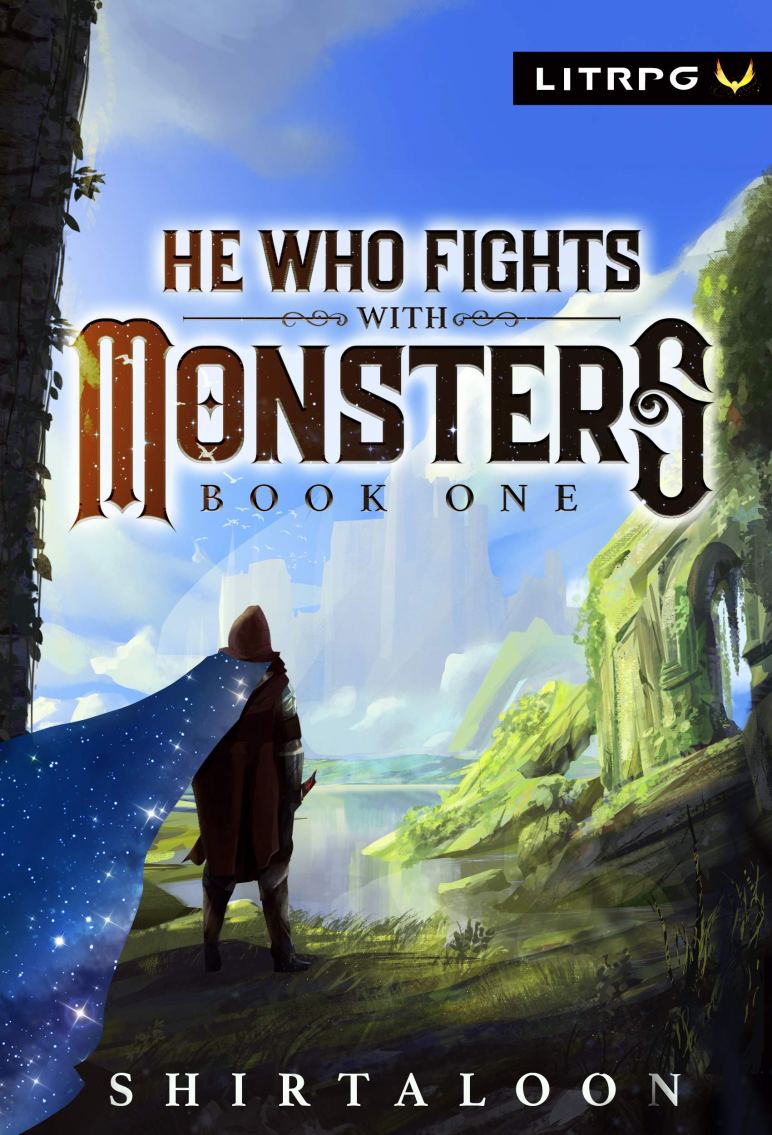
By Shirtaloon (Travis Deverell) | Narrated by Heath Miller | Aethon Books
Light spoilers ahead for Volume 1. Nothing that ruins the ride.
This is the One Piece of LitRPG.
I don’t say that to be clickbaity. When I call something “the One Piece of” its genre, I mean a specific thing: a grandiose story that organically unfolds through its cast, its worldbuilding, its moving parts, and the overall scope of its ambition. It does so while refusing to flatten the thematic ideas and threads woven into the actions its characters take and their consequences on the plot itself. It’s a story that trusts its own scale.
I first wrote my review of this volume on September 4th, 2024, and just finished my fifth listen on April 11th, 2026. In between, I caught up through eleven published volumes, pushed into the Patreon chapters that eventually became Volume 12 (with Volume 13 now in progress), and came back to the beginning more convinced than ever. He Who Fights With Monsters is one of the densest, most rewarding isekai fantasy series I’ve come across in any medium. With a webcomic adaptation from Aethon Books and Vault Comics slated for mid-to-late 2026, and a deluxe hardcover hitting Barnes & Noble shelves early on May 5th before its wide release in July, there’s never been a better time to start.
But let me earn that comparison.
Attention is the Essence
Volume 1 is hefty, one of the best bang-for-your-buck audiobook purchases you’ll find, though individual volume lengths vary across the series. What Shirtaloon does with that real estate is introduce a fantasy world with an almost overwhelming number of names, titles, factions, and locales. Characters are mentioned offhand. Places are referenced in passing. Running gags are seeded so casually you won’t realize they’re setups until volumes later, when the punchlines land and you’re wondering how long Shirtaloon had that in the chamber.
This is what earns the One Piece comparison. It’s not just that the world is big. It’s that the world is tight. Details pay off. Characters return. Lines thought to be throwaways become plot-critical. The tonal range swings from banter that genuinely makes you laugh to gut-punches that hit harder because you were just laughing. The party dynamics between Jason and his companions feel lived-in and earned, rather than assembled by a TV Tropes bullet list. If you’re someone who pays attention, who catches the hints being dropped and files them away, this series will reward you for it over and over again.
Three Mediums, One System
For the uninitiated, let me translate the power system across three mediums.
If you’re a shonen manga fan, think of Essences the way you’d think about Nen categories in Hunter x Hunter, Cursed Techniques in Jujutsu Kaisen, Stands in JoJo’s Bizarre Adventure, or Grimoires in Black Clover. All of these systems share the same principle: your abilities reflect who you are as a person, shaped by your identity and your choices rather than a generic class assignment. Essences operate on that same axis, but with the structured progression of a cultivation novel built in.
If you’re into Wuxia or Murim cultivation fiction, the progression here will feel familiar. Adventurers ascend through ranks (Iron, Bronze, Silver, Gold, and beyond), but you don’t just grind your way up. You have to push yourself past your limits in actual combat and real-world application, then consolidate those experiences through meditation. The consolidation isn’t passive reflection. It’s the conscious act of reasserting your values and identity as you integrate what you’ve lived through. You choose what your power means every time you sit down to process it.
And if you’re a TTRPG player, imagine building a D&D character where instead of picking one class, you choose three Essence concepts from a pool, and the fourth is a confluence Essence determined by how those first three interact. Each Essence grants five abilities that evolve as you rank up, and the combinations are where the real creativity lives.
Before we talk about Jason’s build, you need to understand what he walked into. Jason doesn’t arrive in this world through a summoning circle or a reincarnation truck. He gets isekai-zapped into a hedge maze belonging to an underground cannibal cult. One member of the reclusive noble family connected to the cult, Landemere Vane, happens to worship a dimensional super-god, but the cult itself is its own breed of nightmare. The Essences available to Jason were literally manifested within the confines of a deeply evil locale, which is why Dark, Blood, Sin, and Doom sound like a villain’s loadout.
It’s the kind of build a kid who watched too much anime would design to look as edgy as possible, and the series knows it. Shirtaloon himself describes Jason as “an inter-dimensional kung fu wizard” in his author bio, and Jason later jokes about developing “chuuni tendencies” as he shops for armor and gear that fit his increasingly theatrical powerset. On that note, there’s also a lot of pop culture references, especially from the 80s. Jason uses his bafflingly specific knowledge to put people off-kilter constantly, whether through provocations or by abusing the auto-translation feature built into his abilities as an Outworlder, someone from beyond the local dimension.
But the adventurers who mentor Jason early on teach him something foundational: it’s how you use your powers that makes all the difference, so long as your abilities aren’t officially on the restricted list. His build sounds evil because of where it came from. What it becomes is entirely up to him.
Evil Powers, Good Intentions
Look at what his abilities actually do. Yes, he’s got shadow teleportation, necrotic damage, and affliction stacking that would make any RPG theorycrafting brain light up. His Doom Essence alone carries an ability called “Inexorable Doom” that periodically reapplies existing afflictions and can’t be cleansed while other afflictions are active. Stack that with “Bleeding,” “Necrotoxin,” “Sin,” and “Leech Toxin” and you’ve got a walking debuff engine that punishes enemies for trying to heal.
But then there’s “Feast of Absolution,” a spell from his Sin Essence that cleanses curses, diseases, poisons, and unholy afflictions from allies. He can’t even use it on himself, although “Sin Eater” gives him resistances to those same afflictions. And his “Hegemony” aura increases ally resistances while reducing enemy resistances. Half of Jason’s kit is support. The edgelord aesthetic conceals a healer’s instinct, and that contradiction isn’t accidental. It’s the system reflecting who Jason actually is underneath the provocations: someone who shows up for the people around him even when his whole vibe says otherwise.
That tension between appearance and function, between what the build looks like and what it’s for, is what makes the Essence system more than mechanics. It’s characterization. And it’s something I recognize. I work in oncology pharmacy, sterile compounding chemotherapy in an infusion unit. The drugs I handle are high-alert, potentially toxic, or potentially lethal if not prepared with precision. The work requires intentionality at every step, and the people who benefit from it will never see me do it. Jason’s most important abilities are the ones that keep other people alive, and that’s not the part anyone notices first. I get that.
The Troll Who Means Well
Let me be direct about the only reason not to give this series a chance. His name is Jason Asano.
Jason is divisive. He has plenty of personality, contradictory actions, and political monologues. And I do mean political. Politics are intrinsic to how the plot advances and how Jason’s character arc is defined. If you’re one of those types who “don’t like politics” in their stories, you should legitimately just read something else, because this isn’t a layer you can peel off and still have the same book underneath.
On a fundamental level, Jason’s politics are about resisting authority figures while grappling with the fascist tendencies that come from power tripping. He monologues. He provokes. He irritates people who outrank him by orders of magnitude. He is the distillation of a very specific kind of person, usually on the internet, who can’t help but troll, who has to be the one saying the thing everyone else is thinking but won’t say. The difference is that Jason does this to Bronze and Silver-rank adventurers who could flatten him. He does it to nobility. He does it while he’s still at Iron rank, objectively outmatched by almost everyone he mouths off to.
To understand why he gets away with it, you need to understand what the series calls “the tyranny of rank.” Each rank is orders of magnitude stronger than the last. Higher-ranked adventurers don’t just outstat you; they have innate damage resistance to weaker ranks and can crush your aura with their presence alone. Jason has his aura suppressed by higher-ranked people constantly throughout Volume 1, and every single time, he acts completely nonplussed about it. The reason? He’s felt off-kilter since the moment he arrived in this world, unbalanced and not in control. As he puts it: “You can squash an ant with a boot or by dropping a building on it. It makes no difference to the ant.” He finds it easy to stand up to power because the pressure everyone else finds overwhelming is just another shade of the vulnerability he’s already living with. Ironically, that same overwhelming pressure is exactly the reason everyone else defers.
But here’s what keeps him from being insufferable: the story doesn’t let him get away with it clean. Jason gets flack. He gets callouts. He gets told when he’s being a hypocrite, especially by the people whose opinions he actually cares about, when his righteous monologue is just as self-serving as the authority he’s challenging. He is not a self-insert power fantasy. He is his own character: a distinct, fully realized person working to self-actualize within a world that would be so much easier to navigate if he’d just fall in line and defer to the hierarchy like everyone else does.
He won’t. And that stubbornness is where his sympathy lives.
I Recognize Him
I don’t share a 1:1 connection with Jason Asano. But I recognize him. As a Dominican-American from Washington Heights, I was raised by public systems and by people who instilled the values I carry into every room I walk into. I write because I want to share what’s important to me and because I think others might find value in it, the same way I find value in culture itself, in the artifacts and relics that artists and creators leave behind for the world to interpret and understand. What I recognize in Jason is the conscious choice to question yourself, to evaluate whether you’re staying consistent with your own values, and to keep showing up even when deferring would be easier. I know plenty of people like that. I try to be one of them.
There’s a stretch around the third quarter of Volume 1 that crystallizes everything Jason is about, and it works because of how this world handles divinity. Gods here are manifestations of concepts: Healer heals, Knowledge dispenses information (without much regard to privacy whether you worship her or not, if it doesn’t change the big picture), Dominion grants the divine right of kings, Hero saves people. They exist because the world has enough ambient magic to sustain them, and they maintain proper religions and temples of worship. Jason is an atheist who can’t help but acknowledge their existence when he sees them physically manifest and assert their presence through aura that can and has been witnessed to irrevocably affect people, Essence users or not.
So when Healer publicly intervenes to save Jory’s clinic and expel corrupt clergy, it’s the kind of event that reshapes a city. Healer didn’t just clean house. He healed everyone in Greenstone’s Old City, even regrowing lost limbs, graciously allowing Jory to take the day off from the opening of his new clinic. It was the same clinic Jason helped sponsor through funding Jory’s research and providing free healing to the sick. Divine justice, delivered in person, at a scale no mortal could replicate.
Meanwhile, Jason is off handling something far less glamorous. He picks up an adventurer notice that should have been routine and realizes the poster is about to get blacklisted over a recognizable monster that suspiciously hasn’t been caught. He investigates the way someone from Earth would: looking for paper trails, examining how heavily regulated the surrounding land is for a lumber mill sitting in a desert delta, and using recording crystals the way you’d use a camera phone to document evidence. He sees a political land-grab for what it is and refuses to let it slide.
What makes this moment matter isn’t the action itself. It’s that the natives of this world would have let higher powers sort it out. That’s how things work here. You defer up, you trust the system. Jason doesn’t. He applies outsider logic. He insists on accountability at a rank where insisting on anything could get him killed. The Healer’s intervention is spectacular, but Jason’s is principled. Both are happening simultaneously, and together they tell you exactly what kind of story this is: one where doing the right thing is never the path of least resistance, and the people who do it anyway are the ones worth following.
Heath Miller Makes This World Breathe
I’ll be honest: I don’t listen to audiobooks that often. Heath Miller and this series changed my math on that. A coworker of mine named Ivan, who is also into anime and manga, put me onto HWFWM, and it became my first LitRPG. I recommended The Beginning After the End to him in return, and that became his favorite audiobook series. HWFWM became mine. Heath’s performance was the gateway that led me deeper into the LitRPG audiobook space, where I discovered Travis Baldree through The Primal Hunter and later learned he also narrates TBATE, the web novel by TurtleMe that became a hit webtoon on Tapas and recently got an anime adaptation on Crunchyroll. I got to see Travis and TurtleMe both at NYCC, and the whole experience of engaging with this community of narrators and authors started here, with Heath reading Jason Asano into existence.
Heath’s narration adds a theatrical quality to the material that I wasn’t expecting to love this much. The sheer range of distinct character voices is staggering. I’d estimate north of 98% of the cast has a distinguishable accent or inflection, and that’s not an exaggeration born from enthusiasm. It’s a practical observation from relistening and recognizing characters by sound before the text identifies them. He doesn’t just read dialogue. He performs it.
It’s an impression that builds across the entire book rather than in any single standout moment. Every character sounds like their own person, with their own cadence and affect, and that consistency across a cast this large is a genuine feat. I joined Heath Miller’s Discord and got to listen to private streamed recordings of him working through the Audible sessions, and watching the craft behind the performance only deepened my appreciation. This is an actor with serious range who treats every character, from main cast to one-scene appearance, like they deserve to be recognizable. I’ve also checked out Heath’s work on Heretical Fishing and can confirm the man is a true professional.
In a series where the world is this populated and the names come this fast, having a narrator who makes every voice distinct isn’t a luxury. It’s what makes the density navigable.
Fifth Listen, Still Finding Seeds
I’m not giving this a score. I don’t think a number captures what this series does.
What I’ll tell you instead is that I first reviewed this volume in September 2024, caught up through all eleven published books in about three to four months, pushed into the Patreon chapters, and kept coming back to the beginning. I even got to listen to the completed volume 12 last year after following along through Heath’s Discord. I just finished my fifth listen in April 2026, and I’m still catching things I missed. The details are still paying off. The jokes are still landing. The worldbuilding is still consolidating.
I keep coming back because, at 31 going on 32, I’ve been doing my own version of what this series describes. Revisiting past work, past behaviors, past relationships. Trying to consolidate my own self-actualization. The goal is always to do better, to be a better person that I and my loved ones can be proud of. With all of his faults, Jason aims for that same goal. A story that mirrors that process back to me, that treats growth as something you choose rather than something that happens to you, is the kind of story I’ll always make time for.
The Lineage: Freedom and Intentionality
That word, consolidation, is the one I keep coming back to. In the Essence system, you push past your limits, then you sit with what you experienced and consciously choose what it means to you. The reader’s experience mirrors that progression. Your first time through is the action, the overwhelm, the thrill of a world that refuses to slow down for you. Your relisten is the consolidation, the moment where the details click into place and you realize how intentional every seed was.
He Who Fights With Monsters belongs in a lineage with One Piece and Infinite Dendrogram as stories that share a philosophical core: freedom and intentionality. All three build worlds where the protagonist’s refusal to defer—to systems, to hierarchies, to the way things have always been done—is the engine of the narrative. Jason Asano doesn’t grind his way to power. He chooses his way there, one intentional act at a time, reasserting who he is at every rank. That’s not just good progression fantasy. That’s a story about what it means to grow on purpose.
If you read this whole thing, well thanks mate. Now go start Volume 1.
Written by Michael “Wavey” Peña
 Culture, the Wavey type