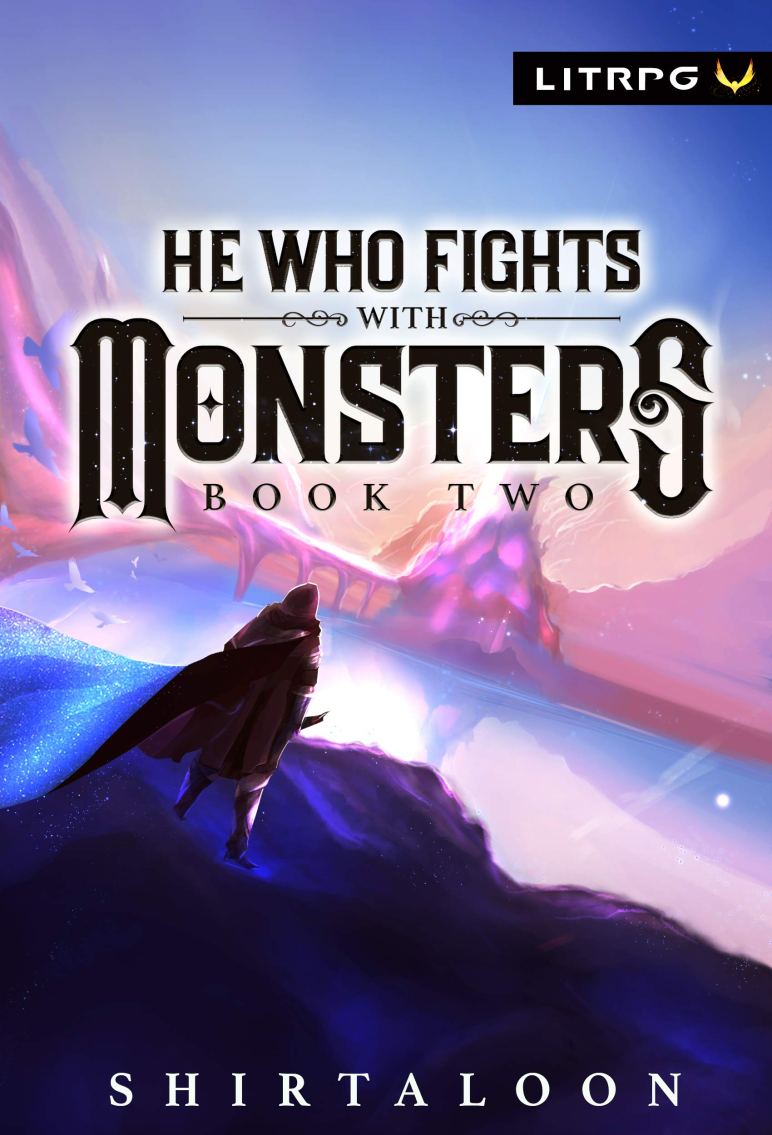
By Shirtaloon (Travis Deverell) | Narrated by Heath Miller | Aethon Books
Heavy spoilers ahead for Volume 2. This is a deep dive on a theme that spoke to me after multiple rereads.
The mark on his back
Near the end of the book, Tilly holds a sheet of dark glass behind Jason’s back and captures an image of his new soul crest. It’s an empty cloak against a dark sky full of silver stars, and inside the cloak is a blue sky with a golden sun where the heart would be. Tilly kills the lights. The crest glows. Humphrey, quietly the most emotionally intelligent person in the room all book, says it looks like the day hidden in the night. Sophie, who would rather die than be caught earnest, says it’s going to get him laid.
That’s the book. The crest is what Jason looks like when he’s stopped pretending nobody lifted him.
Book 2 is about scholarships. Rufus, Gary, and Farrah lifted Jason in Book 1—pulled an isekai’d nobody along after he dragged them out of the jaws of a blood cult and decided he was worth the time, the training, the mentorship. Book 2 is Jason paying that forward to Sophie and Belinda, Gary and Rufus learning to lift themselves now that Farrah’s gone, and the gods lifting Jason without asking him first. Every relationship in the book is a version of a hand extended and a hand taken. The question Shirtaloon keeps asking is what both people owe each other once the hand is taken.
The book also keeps reminding Jason he’s only an iron ranker. The rooms he walks into and the plans he engages with are silver-and-up problems. The kind that get iron rankers killed. Every time, Jason comes out the other side validated by the only metric he trusts: he made the choice he wouldn’t regret, and the people he lifted don’t regret being lifted. Rank is what everyone else keeps measuring. Acceptance is what Jason is actually running on.
After the guests leave
Farrah’s wake has to absorb political figures nobody wants there. Everyone holds it together while the unwelcome guests are in the room. Then the guests leave, and everyone cries.
Jason speaks last and hands the mic to Padma, the Smoulder—Farrah’s protégé, same essences, same lineage, the next person to carry what Farrah carried. Padma is stunned. Jason tells her she already said plenty in private and only needs to say a fraction of that out loud. She does it off-screen as the chapter ends. That gesture is the whole arc compressed: Jason inherited Farrah’s place by accident, Padma will inherit her craft on purpose, and Jason is self-aware enough to know which of them should be speaking.
Gary drinks, Rufus teaches
Gary and Rufus grieve in parallel. Gary picks up a habit of drinking strong, cheap alcohol, the kind nobody chooses for the taste, and Rufus notices and gently raises it, though he doesn’t push. He’s processing too. Rufus’s answer is to step back from adventuring and partner with the Gellers to build a school. It reads less like grief-coping and more like an experiment: can what Farrah taught him scale? Gary’s trying to outrun the grief with his hands. One of those is working better than the other, and the book lets that sit without editorializing.
Sophie and the longest road
Sophie’s arc runs the whole book. Humphrey drills her before the adventurer exam, patient and unflashy, the way Humphrey is patient and unflashy about everything. Then the Reaper trials force her and Jason into a team, and they come out of it as actual friends.
The thing the book never lets you forget is the indenture contract. Jason holds the line on it: refuses to use the power it gives him, treats Sophie like a person who happens to be bound to him instead of a bound thing that happens to be a person. He jokes about it, because Jason jokes about everything, but he keeps the actual power in reserve.
Stay or go
It’s not free for him either. Sophie keeps threatening to leave and not leaving. By the time the trials end, she’s earned enough to pay the contract out herself. The rope is gone. And she still won’t say whether she’s staying.
That’s when Jason finally blows up in private. He needs an answer. Stay or go. A team can’t run on someone who’s always halfway out the door, and the careful ethical posture he’s been holding was never sustainable forever. Sooner or later he needs her to choose him back, not because the contract says so but because the team needs it.
Clive says the quiet part out loud earlier in the book. He sees Jason white-knuckling the ethics of the contract and tells him: your friends are here for that. You don’t have to carry the whole question of being a good person by yourself. We’ll tell you when you’re getting it wrong.
That’s the interpersonal thesis. A scholarship isn’t only the lifted person accepting the lift. It’s the lifter accepting that being decent is collaborative work. Sophie meets him halfway. She chooses him freely, with nothing holding her in place but the choice.
Team Biscuit, the second scholarship
Sophie and Belinda were always a package deal. Clive sees Belinda’s knack for magic items and pulls her into his work. Neil is different: already trained, already capable, teamless because Thadwick burned the bridge. Jason’s pitch to him isn’t why Neil needs the team. It’s why the team needs Neil. That’s the right pitch for a person who’s already proven himself. Neil takes it away and thinks about it. He even asks Thadwick’s mother, Thalia Mercer, what she thinks of Jason while Jason was dating Cassandra. She approves, and compares Jason to Danielle Geller. Neil chooses. Not everyone in a scholarship frame is someone you rescue. Some of them are people who could go anywhere and pick you anyway.
After the Reaper trials and Emir’s contest for the Order of the Reaper’s legacy scythe, the team rounds out their powers together. Belinda’s acceptance is the quiet one. Most of what she needs is common enough that the post-trials market covers it, but the rare stones make her nervous. Clive has to talk her into accepting them, for her own good and the team’s, which are the same thing once you’re on a team. What she has to accept isn’t anyone’s generosity. It’s that being carried isn’t a debt. It’s what being on a team means.
Shade, Gordon, and being a chuuni forever
With the team’s powers squared away, Jason’s new familiars arrive. Shade rises from black flame as a silhouette in a cloak and greets Jason like an old friend. Gordon comes through the dark as an orange-and-blue nebula eye draped in a cloak, with two smaller eyes orbiting it. The team is poised to mock the incantations and ends up transfixed instead.
Jason’s response: Ah, crap. I’m going to be a chuuni forever.
Read it seriously. The chuuni line is Jason accepting that the theatrics are the self, not a phase. Shade and Gordon answer because he called in his real voice. Shade in particular chose Jason—he asked Jason to use the Reaper token in the awakening ritual, which was basically a request to be summoned. Familiars picking their summoner.
The running gag lives here too. Humphrey tells Sophie that Gary tried to bet him the incantation would be really evil. Sophie asks if he took the bet. Humphrey says gods, no. Jason asks if they mind. Jason is the butt of it and plays along. The mockery and the awe aren’t in tension. That’s how this team loves each other.
The gods don’t mind the blasphemy
Jason frees the time-displaced clergy trapped in the Reaper’s astral space. Six gods mark his soul for it, and they do it in public. Jason is openly, cheerfully blasphemous, and the gods showing up to bless him anyway is their answer. They don’t care. Or they care in a way that doesn’t require him to behave.
The two who speak are Dominion and Healer. Dominion already said in Book 1 that he likes Jason for refusing to kneel. Healer speaks because he’s watched the altruism, the clergy, the Greenstone work, the long pattern of Jason doing the right thing without a receipt. The mark isn’t a stranger’s stamp. It’s recognition from gods who were already watching.
But it’s also a bill. The mark is permanent, soul-deep, and public. It makes Jason legible to a much bigger political world: Valdis of the Mirror Kingdom, Zara Rimaros and the Storm Kingdom, Emir, Rufus’s parents and their stories of Vitesse. The gods bet on him because they’d already seen him doing the work.
Freeing the clergy is also the clearest single example of the iron-ranker problem. No iron ranker should be doing what Jason did in the Reaper’s astral space. It’s a job for ranks he hasn’t touched yet. He does it anyway, and the six gods mark him for it, and the room around him recalculates who he is. The rank on paper hasn’t changed. The level of responsibility the world is now assigning to him has.
Marks have edges
The marks have limits. Gods govern worlds. Their authority stops at the edge of this one.
Great Astral Beings are a tier above gods. They govern cosmological concepts that run across all of reality: the Reaper holds the finality of death, the World-Phoenix holds the integrity between worlds, the Builder holds an obsession with physical reality it can’t itself inhabit. Death, the goddess, ferries souls from the physical to the astral; the Reaper is the concept she serves. The six gods on Jason’s back can recognize him. They can mark him. They can’t reach the tier where the real threat lives. The recognition is real. The protection is local.
The team marks itself
After the gods mark Jason, the team marks themselves. That order matters. The crest wasn’t Jason’s choice. The tattoos are.
Neil takes a mana potion equivalent, self-healing for his own reserves. The healer deciding that taking care of himself is part of the job. Belinda takes a spell recharge she can route through her essence ability to refill anyone on the team, which is Belinda in one sentence: the lockpick who grew up surviving alone is now permanently wired to give her team their power back as she fills different roles with her own power set. Every tattoo is a statement about who the person has decided to be on this team.
Jason got the crest. The team gets spellwork in their skin. Imposed mark and chosen marks on the same bodies. The scholarship made literal.
Thadwick was the thread
Thadwick is sprinkled through the book, and by the end it’s obvious he was never a subplot. He was the thread.
His mother purged his Star Seed. He went back to the Builder cultist Timos and asked for another one. He walked out of the Mercer lineage on purpose. In the scene with Timos, Thadwick floats bringing his father in. Timos laughs at him. His father isn’t an entitled child grasping at power he thinks he deserves, and will never serve the Builder. Then Timos tells him the good news: the next astral space the cult claims will scour the Greenstone delta as a side effect. Thadwick’s family included. Thadwick asks about his father. Timos tells him he’s already betrayed them.
Thadwick is the reason Neil was teamless. He’s part of why Jonah, Humphrey’s cousin, is dead—Thalia wasn’t willing to put her son forward to be screened and purified, so the Gellers went first. Danielle trusted the Church of Purity to safely cleanse the Star Seed out of her nephew, and the archbishop, who had known what Star Seeds were all along, let it tear through Jonah and acted surprised. The Church and the Builder cult are running the same play. The Gellers are a target, because with the Mercers already compromised, the Gellers are the family most likely to stand in the way.
Not just the Gellers. Not just Greenstone.
Clive puts it together in a room with Emir, Arella, Thalia Mercer, and the archbishop. The Builder is a Great Astral Being. It can’t exist in physical reality, so it’s building a reality of its own in the deep astral out of stolen astral spaces. Astral spaces anchor to worlds; tear them off catastrophically and the space survives while the world gets wrecked. The process the cult was running in Greenstone would save the space and destroy the delta. Reports are coming in of the same pattern hitting astral spaces all over the world. Civilization-ending destruction, coordinated, at a tier where diamond rankers are the minimum response.
The Church of Purity is doing the political work a Great Astral Being can’t do directly. Hollow out the families. Neutralize the opposition. Prepare the ground. The Builder reaches in from outside when the room is ready. Jason was right in Book 1: people who talk about purity all the time, when left alone, get enthusiastic about purging the unclean and rounding people into camps.
Anissa, in Book 1, was the Church of Purity’s contact who steered Rufus’s team to the Vane estate. The Landemeres were in the wrong cult and marked for purge, with Landemere excluded so the Builders could use the estate as a base. Jason killed Landemere and his parents in self-defense, which closed one chapter of the conspiracy and started the next. The Church and the Builder have been running this play through Greenstone for years. Maybe decades. Book 2 is the book where the play becomes visible.
Thadwick is the photo negative of the team. The lift without the lineage. Power without accountability. Ascension that refuses to be carried and refuses to carry. Every acceptance the team does in this book is happening while a conspiracy is hollowing out the families around them, routing a Great Astral Being’s work into their city, and stripping the delta for parts, while the same machinery does the same work on worlds the team will never see. Team Biscuit is what acceptance builds. The Church and the Builder are what refusal organizes at civilizational scale.
The day, hidden in the night
Back to the crest. Sophie’s joke lands differently by the end. The day hidden in the night is what honesty looks like when someone stops needing the performance to be a lie. The theatrical Jason and the real Jason are the same person. Book 2 is the book where he stops pretending otherwise: accepts the lift made on him, makes the lift on Sophie and Belinda, takes the mark the gods put on him without flinching, and gives Padma the mic.
He’s still an iron ranker. Book 2 doesn’t change that. What it changes is the size of the rooms he walks into. The political room, where Valdis and Zara and Emir’s networks make him legible to kingdoms he’s never set foot in. The magical room, where the Builder’s scheme shows him that gods are not the top of the ladder, and the ladder has rungs that don’t run through this world at all. The planetary room, where Clive’s briefing makes clear that Greenstone is one target among many and the threat is global. Book 2 is the book that shows him how much bigger those rooms are. Book 3 is where he has to walk further into them, still iron-ranked, still making the choice he won’t regret.
Written by Michael “Wavey” Peña
 Culture, the Wavey type