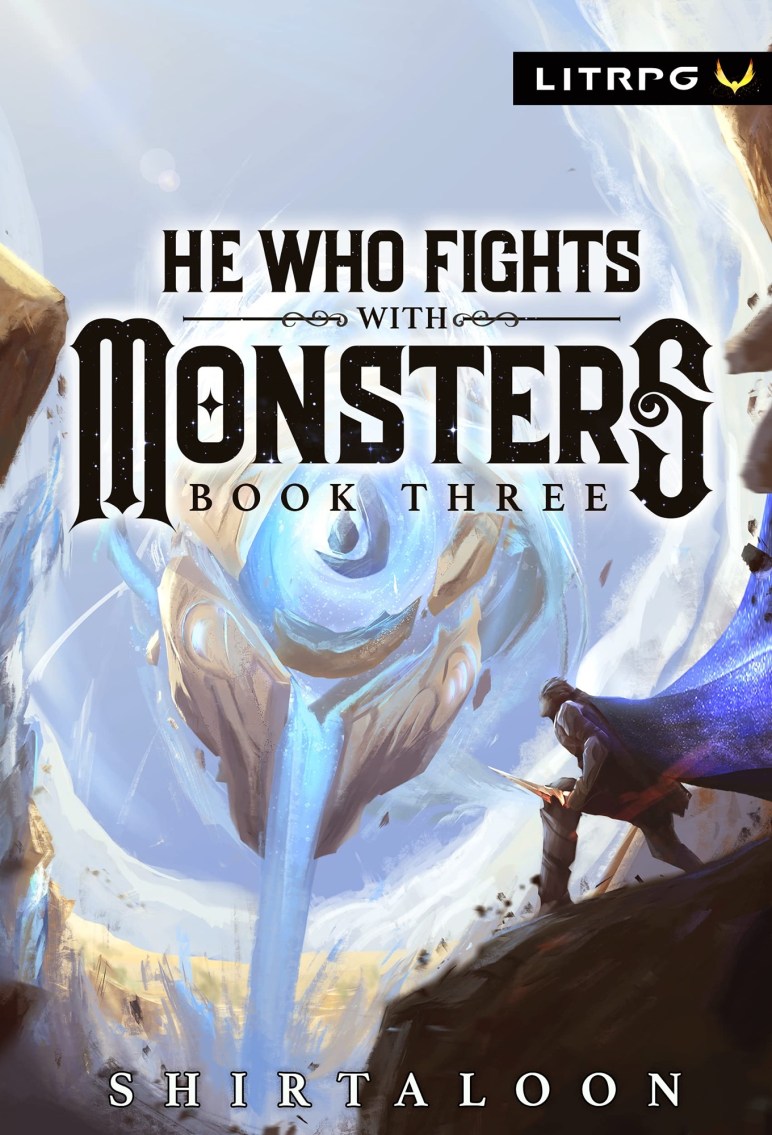
This is an original essay on He Who Fights with Monsters Vol. 3, made by reviewing my fifth reread/close listen of the audiobook/kindle versions. By recapping certain events with my lens, I hope to prove a thesis about the themes of this first Saga of the series.
By Michael “Marion” Peña
I. What the Grandfather Said
The Grandfather’s Lesson
In Book 1, Rufus Remore tells Jason about his grandfather. The cast knows the bit: the school his family runs is a pedigree Rufus cannot stop reaching for, and the grandfather is the well he keeps lowering the bucket into. By the time you’ve spent a few hundred pages with these people, an invocation of the old man lands somewhere between a punchline and a drinking cue: Farrah groans; Gary smirks. Rufus is about to be insufferable, lovably so, and someone is about to tell him.
This is what makes his use of the line, after Jason’s sand elemental fight, register the way it does.
Jason has just improvised his way through a monster he had no business surviving, using a half-remembered myth from his world about a guy who was invincible while touching the ground, killed by being lifted into the air, to figure out a creature he doesn’t have the training to read. Rufus tells Farrah, who has just credited Jason’s win to luck, what his grandfather says: the great adventurers are the ones who turn luck into fortune.
Farrah calls it male posturing. She groans about little boys and their schools. The bit holds. Later, with Danielle Geller, Rufus reaches for the grandfather again, this time to identify what Jason showed him: what it means to be an adventurer. When all your training and powers fail you, you have to find something inside yourself you never knew was there. Then you can do things you never thought possible. It’s the difference between a good adventurer and a great one.
Rufus is the grandfather’s apostle, and the cast is the chorus that mocks him for it. Farrah just stops dismissing what Rufus is saying long enough for the reader to clock that this time, the bit is doing real work.
Rufus’s training method earlier in the book spells it out. Three legs: observation, danger, meditation. The first two push limits. The third consolidates, taking the fleeting moments in which you were better than you’ve been and making them part of who you are. The grandfather’s line is the slogan. The training is the practice. Together they describe a kind of greatness that doesn’t depend on raw power: greatness is the alchemy that turns chance into permanence. Lucky moments, dangerous moments, moments above your station, collected and kept.
Vol. 2 ended with Jason’s arrival. Trials survived, team formed, the kid from Earth recognized as an actual adventurer. He had earned his place.
Vol. 3 is the Invoice
Shirtaloon names the thing in Chapter 69: A War of Stolen Moments. By the time we get there, the cast isn’t joking anymore. The grandfather’s lesson has matured into the chapter title. The lesson that survived being mocked across two volumes is the only one left when the enemy is a Great Astral Being and the territory is your soul. Vol. 3 is what happens when a kid who was supposed to turn luck into fortune is asked to steal sovereignty back, in pieces, from a being whose scope is above planetary gods.
The volume opens with the bill. At Quarry Village Number Four, Jason buys time for a fleeing population by drawing the attention of the Oasis Tyrant, a silver-rank monster he should not have been on the same plane of existence as on Earth, let alone fighting two ranks above his own. He survives because Colin subsumes into his bloodstream and turns Jason’s body into something that recovers faster than it should. Shade rides his shadow; for each body subsumed, Shade masks one giveaway sense, scent or heat or sound. Gordon rides his aura, sharpening Jason’s ability to retract it completely, until even bronze-rankers can pass him without a flicker.
He is an iron-ranker carrying a healer in his bloodstream, a hider in his shadow, and a guardian in his aura. Gordon and Shade die in the encounter. Jason walks out with his first soul scar, the body scar that runs from hip to shoulder and imprinted onto it, and a new title: Resolute, marked on his soul because he stood up to a higher-ranked foe and would not bow. Henrietta Geller, who has seen more of these moments than the iron-rankers around her, calls him a true adventurer. Neil, after Jason tries to slip past the villagers he just saved without accepting their thanks, tells him that if he’s going to run around playing hero, he has to accept people’s gratitude.
It is a moment of confirmation. Rufus was right about him in Book 1. The grandfather was right in whatever century he said it. Jason is the kind of adventurer the lesson was for.
It is also a moment of inscription. The Resolute title joins the marks already on Jason’s soul, including the one the six gods left him with at the end of Book 2, after the reaper trials: Godless Prophet. To be acknowledged in traces of your soul by the gods while refusing to bow is to be marked Godless Prophet. Shirtaloon’s system is doing something a religious reader will recognize. Souls in this world are not abstractions. They are surfaces that take impressions, register encounters, and remember them as identity. Stand up to a higher-ranked foe—marked Resolute. Meet the gods and refuse them: marked Godless Prophet. Let a star seed in, as Vol. 3 will demonstrate at length: marked something much worse. Every survived encounter with power that exceeds your own is a baptism of one kind or another. You don’t always get to choose the name on the certificate.
The soul scar from the Oasis Tyrant, and the body scar that imprinted onto it, are the first charges in a currency Jason did not know he had. Notice what kind of interior is being charged: a soul that hosts a healer in its bloodstream, a hider in its shadow, a guardian in its aura. Jason’s soul is not, even in Vol. 3, a private chamber. It is already accommodating other beings. The volume will spend the next six hundred pages teaching him what else can be taken from, claimed against, and built on that interior.
— — —
II. The Soul as Contested Ground
The Cell
Halfway through Vol. 3, Jason wakes up in a cell.
The chain that put him there is worth tracing because Shirtaloon has been careful about it. Killian Laurent, an elf working under Cole Silva, had let the Builder cult quietly infest Old City’s underworld during the purge, giving them cover in exchange for resources. When Jason became a problem the local powers wanted handled, Killian engineered a plan the cult itself was not party to. He had a star seed already. He had a device he had built without the cult’s involvement. He brought Sparrow, a silver-rank operator, into Silva’s orbit through Lamprey, framed as a deniable third party who could profit from Silva’s other ventures while the kidnapping ran. (The text is careful about Sparrow’s other ventures. The reader is allowed to infer.) Silva delivered Jason. Killian got to use the seed he already owned. When the plan failed and the city moved against him, Killian escaped by feeding Silva to the response as a distraction.
This matters not as plot mechanics but as theology. The agents are Killian, who wanted Jason neutralized; Silva, who wanted him gone for profit; Lamprey, who signed off; and Sparrow, who collected. The cosmic violence in Vol. 3 arrives wrapped in mundane corruption. The crime lord and the elf are not the Builder’s pawns. They are the delivery system for a metaphysical assault none of them fully understands. Worldly evil and cosmic evil are running the same operation because Killian found a way to make their interests align.
What follows in the cell is the first real test of everything Section I established. Jason’s body is suppressed by a collar. His team is elsewhere. His powers are throttled. The grandfather’s first two legs of training, observation and danger, have been removed by force; he cannot push limits because he cannot find them. What’s left is the third leg, consolidation, and the soul that has to do the consolidating.
He refuses to eat. The text gives this its proper rationale: Jason has studied enough magical theory to know the soul is inviolable unless its bearer grants access. Eating something his captors offer is granting access. He calls it a “magical EULA”. The phrasing is Shirtaloon’s, through Jason’s voice. You don’t just click, “I agree” on a star seed. The Builder imprints itself on souls that relinquish access, and without the seed as channel, it cannot exert control. The device cannot install the software without the user accepting the terms. So Jason doesn’t accept the terms. He is hungry and afraid and very alone, and he doesn’t eat.
This is Rufus’s grandfather speaking through clenched teeth. When all your training and powers fail you, you have to find something inside yourself you never knew was there. Jason finds it. What’s inside himself is a refusal, sharpened to a knife edge by the fact that he’s read enough magical theory to know exactly what relinquishing access would cost.
He escapes by stealing the only moment available to him: the key from a dead man’s pocket, after a fight he barely wins. On the way out, the suppression collar teaches him something about the soul his teachers had not. With his body throttled and his magic sealed, awareness is the only sense the collar leaves him, and he becomes aware of the shape of his own aura in a way he hasn’t been before. He realizes mid-escape that defying the star seed has done something his teachers couldn’t: it has clarified his soul to him. Trauma as accelerated consolidation. The third leg of the grandfather’s training, the slow meditation that turns fleeting moments into permanent self, is happening to him under threat. He gets out of the cell with better aura control than he had when he went in.
The Houseboat and the Projection
The recovery happens in the houseboat. Carlos Quilido, an old colleague of Rufus’s mother Arabelle Remore, is the man Arabelle calls when an adventurer’s soul has been touched by something that should not have touched it. He is a kind of magical psychiatrist. Arabelle is closer to a trauma therapist. Together they take Jason apart and put him back together, daily, on the houseboat. Carlos teaches him magical theory of the soul; Arabelle walks him through the memories that imprinted on him during the time he had no mind to record memories with. Aura training continues, because in cases of soul trauma, aura training is how you re-establish the sense of self. Jason becomes, almost by accident, the best student of the soul on his team. He had to.
The reconstructed self holds well enough that Jason can make jokes again. He sits through a meeting with Carlos and tells Clive, deadpan, that Clive has been crabby ever since Jason slept with his wife. He waxes winsome about being a homewrecker and quotes O.P.P. at no one in particular. The Jason who plays the room is back. Then, in the same conversation, Carlos mentions he would be fascinated to examine Colin, and Jason’s face freezes.
You can prod and poke me all you like, he says, in a voice the text describes as hard granite. You come after Colin, though, and I don’t care who sent you or what rank you are. I will find a way to kill you.
The temperature drops. Rufus, watching, registers what the others are slower to clock: Jason’s return to his old self is a constructed facade. The performance is real but the man underneath has been changed permanently. The threat to Colin pulls the thread that unravels it. And the threat is specifically about Colin, the familiar who lives in Jason’s bloodstream. The thing Jason will not allow examined is the resident of his interior. The same instinct that refused the star seed refuses Carlos’s professional curiosity. The soul has tenants and they are not specimens.
Carlos is undeterred. He proposes a soul projection ritual to confirm Jason’s soul is intact. It is a gold-rank ritual filtered through an iron-rank vessel, and Carlos worries the ritual will overdraw against Jason’s soul to produce the projection. It does not. The aura that pours out of the marina district when the ritual completes is, in the text’s words, less the personal power of a sovereign than a celestial law passing over the area, filled with unyielding resolve and an echo of divine power. Bronze-rankers withstand it. Iron-rankers shake. People without aura senses feel only foreboding. The Marina North district has been visited by something it has no rank-language for, and that something is Jason’s soul, briefly visible. Carlos confirms what the projection shows. The soul is unviolated. The aura fades.
The reader is supposed to feel reassured. The reader is also supposed to notice what the ritual incidentally proved. Jason’s iron-rank soul, when pressed, channeled a gold-rank ritual without buckling. His soul is already, structurally, a place that can host power scales it has no business hosting. A healer in its bloodstream. A hider in its shadow. A guardian in its aura. A gold-rank ritual passing through it without damage, projecting outward as something the neighborhood mistakes for divine law. Vol. 3 is not yet ready to name what this means. Neither is Jason. But the architecture is being built.
If the soul is a contested place, the question Vol. 3 keeps sharpening is the one Jason cannot quite ask yet: what does it mean to live in such a place? To make a home in something gods, monsters, and crime lords all consider real estate?
Section III is the answer the volume offers, and it is a theological one.
— — —
III. Resolute, A Theology of Refusal
After the houseboat, Jason finds himself with political capital he did not seek. Danielle, in one of those political mentor conversations the volume keeps quietly threading through, makes him aware of what his survival means in Greenstone’s social ledger. He has rooted out an underworld boss who let the Builder cult take quiet hold of the city. He refused a star seed and walked out of the cell intact. The polite layers of the city owe him something they have not yet found a way to pay.
The chance to cash in arrives at a high society event. A drunkard at the party, a noble quietly counted among those annoyed by Jason’s sharp rise through both adventurer and high society circles, says aloud what some of his peers have been thinking: that Jason has been working with the cult all along, and that the casualties of the previous astral space expedition, the Greenstone adventurers killed fighting the cult, including Farrah, are all on him. Jason responds without speaking. He turns his aura on the man and quiets him with it.
Hegemony in Public
The aura has a name. Hegemony. It comes from his Sin essence and the name is precise. Hegemony isn’t the brute power to make a room shut up. It is the power to make a room recognize that the speaker has the standing to pronounce. The drunkard isn’t silenced by force. He is silenced by a verdict, delivered in the only register Jason’s essence permits, which is the moral one. The adventurers in the crowd register the verdict and ratify it. They don’t respect Jason because he is stronger; they respect him because he spoke for the fallen, not for himself. That ratification is what hegemony is. Dominance accepted as authority. The Duke notices.
The audience that follows is not one Jason had been pursuing. It is one he uses, and what he asks for is sharper than charity. He asks the Duke to install Adris Dorgan as mayor of Old City. Dorgan is one of the underworld’s three most powerful figures and the one most invested in legitimacy, made palatable and plausible as a civic authority by the fact that his daughter, Elspeth Arella, is already director of the Adventure Society’s Greenstone branch. Old City has always been governed by underworld figures in practice. Jason is asking the Duke to recognize that fact rather than fix it from outside, to give the part of the city no one else advocates for a mayor who actually represents it. The Duke, who has just watched Jason silence a peer at a party with nothing but his soul, agrees.
It’s the same pattern twice. Jason quiets the drunkard on behalf of dead adventurers who cannot defend their own honor. He pressures the Duke on behalf of Old City residents who have no access to that room. The instinct is the same, scaled up. He uses what power he has on behalf of people who cannot speak for themselves. There is a name for what this looks like, and the volume is not pretending the shape is accidental.
What complicates the read is that Jason is an atheist. Or rather, he was. He came to this world from an Earth where the gods were, to him, a category of fiction. He has now been confronted with their literal manifest reality. They have appeared in front of him. They have spoken. They have, at the end of Book 2, marked him. He has had to update his metaphysics under duress. He has not updated his loyalty.
The mark the gods left him with names this exactly. Godless Prophet. The Hebrew Bible is full of prophets who deliver judgment as supernatural harm: Moses calling down plagues on Egypt, Elisha cursing the youths who mocked him until bears come out of the woods. Deuteronomy lays out the vocabulary. Pestilence. Fever. Inflammation. Hemorrhage. Sickness on the body of the unrighteous as the visible cost of a broken bond. Jason’s spell list is in this vocabulary: Castigate, Haemorrhage, Punition, Verdict, Inexorable Doom. Not damage types. Courtroom and sanctuary words. The contemporary fantasy reader is going to reach for plaguemancer, which isn’t a real word, but we can thank necromancers for the vision. The older name for the figure is just prophet: the kind who delivers curse-sickness on the unrighteous on behalf of a broken bond.
The Godless Prophet
The difference, and it is the whole difference, is that Jason serves no god. He acknowledges they exist. He has met them. He refuses to work for them. He does the work of the prophet anyway, on his own authority, against whichever cosmic power happens to deserve it.
Look at how the spells fire. Castigate: Carry the mark of your transgressions. Haemorrhage: Bleed for me. Punition: Suffer the cost of your transgressions. The spells are spoken, and what is spoken is sentence. The mechanic is the theology. To trigger the affliction, Jason has to pronounce what the affliction is for.
This is more presumptuous than the older prophets, and the volume knows it. When Jason first shared his powers with his team so they could plan strategy together, Neil was the one who named the danger out loud. A prophet under God can at least claim he is not the one passing judgment, only delivering it. Jason has no such cover. The sin essence routes the verdict through his own moral compass and the spells confirm it by inflicting curse-language on the bodies of the convicted. Jason isn’t just a prophet without a god. He is a prophet who has made himself the source of the verdict. In any normal religious framework, that is blasphemy. In Jason’s case, it is also, frequently, the only way the work gets done.
This is the tension a certain kind of reader hates about Jason and the volume keeps pressing on anyway. He gets self-conscious about his power. He worries about getting lost in it. He has slipped before and the text knows he will slip again. Readers who came for the power fantasy register this as whining. The volume registers it as the only thing standing between Jason and tyranny. A prophet who decides who is guilty and inflicts the sentence himself, with no higher authority to appeal to and no doubt about his own righteousness, is not a hero. He is a tyrant who happens to be on your side this week.
Jason’s self-questioning is the difference. It is also, not incidentally, what a religious reader will recognize as conscience operating in the absence of authority, which is the condition the tradition both demands and warns against. A Catholic reader’s nightmare and a Catholic reader’s recognition at the same time: a man insisting conscience is enough, when conscience is exactly what the tradition says will deceive you when it operates alone.
The volume sits with this danger without softening it. Vol. 3 doesn’t yet show what Jason becomes when the soul architecture catches up to the prophet architecture, when his interior turns out to be a place other people can shelter in. But the seed is here. The man who refuses to act for the gods is on his way to being something the people he protects will not have a more accurate word for than divine.
The system already has a name for him. Godless Prophet. The system was not being poetic. It was being precise.
— — —
IV. A War of Stolen Moments
By the time the team grinds up to mid-bronze rank in the astral space, fighting through monsters that get harder as the magic gets denser, everyone knows the chapter title before Shirtaloon does. Roland Remore, Rufus’s diamond-rank grandfather and the family member the cast has been mocking Rufus for quoting since Book 1, taught a method: forge yourself into a weapon by trial of fire. Three volumes of training have compounded. The team is outnumbered by the cultists and the Church of Purity. They are not stronger than the Builder’s constructs. They are fast enough and strange enough and selfless enough to keep finding moments the bigger thing didn’t think to guard.
Each One A Moment
And the text is careful about who gets which. Humphrey leads by holding ground, Superman not as the strongest fighter but as the one whose presence makes the others braver. Clive is the true student of magic and, in a way the genre rarely allows, the actual hero of the volume. The Builder fight is won because Clive has the right training to use the tools available; the tower reset that sends the team home is his solution, found by the only person on the team capable of finding it. Jason draws fire so Clive can think. That is how the fight ends. Sophie moves through the camp like a spectre, swift and ghostly and untouchable, exactly as the chapter’s first sentence describes her, because she has internalized the lesson more thoroughly than anyone. Belinda, with the time she did not have until Jason gave it to her through essences, is the team’s strategist. Neil is the conscience that keeps Jason honest and has been since the strategy session.
Farrah’s absence sits differently. She was Jason’s aura instructor, and the aura is what he has been fighting with for the entire volume: silencing the drunkard, the projection ritual, the war of stolen moments itself, which is largely a war over who can stand where they should not be able to. Every aura beat in Vol. 3 has Farrah’s technique under it, even when Jason is using the technique to do things she would have rolled her eyes at. She did not share his moralizing. She would have been the one to cut the bit on his self-righteousness the way she cut the bit on Rufus quoting his grandfather. Her absence is the loss of that pressure. Jason fights the Builder partly to make her death matter, but he fights with her techniques and without her judgment in the room, and the second loss is the harder one.
Jason’s role across the climax is to be present, infuriating, and impossible to ignore. The Builder does not need to defeat the team; it outranks them in a category that does not admit defeat in their sense of the word. So the team’s job is not to win. It is to deny the Builder what it came for long enough for Clive’s solution to fire. Jason is the lure. He is annoying enough to draw the eye of a being whose scope is above planetary gods, which is its own kind of theological achievement, because the Builder has to acknowledge him to be annoyed by him. He does what he did to the star seed, scaled up: refuse to be ignored, make the cosmic power deal with him. Resolute. Clive, meanwhile, does the actual work that gets them out.
The Operating Manual
Earlier in the volume, Jason gives the team a small speech about politics, and the speech is the operating manual for everything that follows. He conjures his dagger and calls it the weakest weapon there is. A blade can cut down a person, but words can bring down a kingdom. He tosses the dagger and it vanishes. Everything is a weapon. The trick is learning to wield them without doing yourself an injury. Sophie tells him he likes to hear himself talk. The team laughs. The line stays. Aura. Speech. Posture. Reputation. Selflessness. Annoyance. The team wins by recognizing what counts as a weapon when conventional weapons are not enough.
The war the volume ends on is the war it opened on. Quarry Village Number Four was Jason buying time for villagers with nothing but his presence and a willingness to be hit. The Builder fight is the same trade at cosmic scale. Jason draws the eye of something that should not have to look at him, and the team uses the time the looking buys them. Clive is at the center of the use. The grandfather’s slogan, Roland’s method, the chapter title, the spells, the operating manual: all the same idea in different registers. Greatness does not depend on raw power. It depends on what you do with the moments raw power does not control.
Jason wins by not winning. The team wins by not winning. They survive long enough to escape, which is what Roland’s training was always for: outlasting what you cannot beat. The grandfather was right. Rufus was right to keep saying it. Farrah was right to mock the bit even while teaching the technique it described. The cast was right to mock the bit too, because the bit had to survive being mocked before it could be confirmed under fire. By the close of Chapter 69, the lesson is no longer a lesson. It is just what the team does.
— — —
V. The Camera Pulls Back
Interstice
In the back half of Vol. 3, Shirtaloon does something the genre rarely permits at this scale. He pulls the camera all the way back, far enough that Jason becomes a small figure in a much larger frame, and lets the reader see who has been arranging the furniture.
In the epilogue, the room is the world known as Interstice. It is the widely accepted capital city of the cosmos, a place where Great Astral Beings can meet through their vessels, because the beings themselves cannot share a space without ending the worlds below. The vessels are diamond-rank, the mouths the GABs speak through, because direct contact between cosmic powers and the world below is the kind of contact that ends those same worlds.
Three GABs at the table: the Reaper concerned with finality of life, the Builder concerned with world-making, and the World Phoenix concerned with dimensional integrity. The Builder has been moving on Jason’s adopted world for reasons that have nothing to do with Jason. The Reaper has interests of its own, structural and old. The World Phoenix is the being whose nudge brought Jason to his adopted world in the first place, and the volume is careful about how that nudge is described. Jason was not chosen. He was not selected as a candidate. The World Phoenix nudged a coincidence at the moment of Jason’s death on Earth, and Jason fell through it. A being of its scale does not give orders. It tilts the conditions under which choices are made, and lets the choices happen.
This is theology again, in a different cadence. The God of the Hebrew Bible speaks in burning bushes and pillars of fire because direct address is itself a kind of restraint, a willingness to intervene. The World Phoenix does not intervene. It nudges. The reader has spent two and a half books watching Jason exercise free will, refuse star seeds, mark his soul Resolute by his own choice, and the camera pull-back does not cancel any of that. It reframes it. The choices were Jason’s. The room he was making them in had been quietly furnished.
A concession is offered in the negotiation. As partial recompense for what Jason has been put through, another outworlder will be sent to the same world. Not a rescue. A peer. Someone who will not look at Jason and see only the strange one. The volume mentions them and does not yet name them.
Dawn and Helsveth are present in Interstice on the edge of the negotiation. Dawn, a Celestine, is the World Phoenix’s vessel, in the city on a mission for her patron. Helsveth, a Draconian, is forty years old and diamond-rank in a class of figures who reached that ceiling over centuries. The volume is direct about the trade-off: Helsveth was put through an accelerated program by the cult of the World Phoenix, her challenges designed and her setbacks engineered, and the result is a true believer the old guard families intend to use as a puppet. Dawn is of a mind to cut the strings. Helsveth’s situation is the inverse of Jason’s, and the contrast is the whole point. Jason’s challenges were not designed. His seasoning came from the trials he survived because Roland Remore’s method demanded it.
What Interstice does, beyond plot mechanics, is locate Jason. He has been operating, across three volumes, as if his choices were his own and the consequences fell within the scope of his world. The pull-back shows him operating inside a frame whose edges are held by beings he cannot perceive, between whom there are agreements he cannot read, on whose negotiations his survival depends. The same iron-ranker who silenced a drunkard with his aura at a Greenstone party is, from Interstice’s vantage, a piece on a board so large he cannot see its edges.
Shirtaloon does not ask the reader to find this depressing. He asks the reader to notice that Jason’s choices have mattered anyway. The Resolute mark is real. The refusal of the star seed is real. The hegemony Jason exercises in Greenstone society is real. The grandfather’s lesson does not require an unrigged world. It requires a person willing to turn whatever moments the rigging permits into something permanent. Jason has been doing that. Interstice confirms that the moments were always smaller than he thought, and that he made them count anyway. None of this bigger picture politics affects the potential and growth the soul is capable of, even at iron-rank.
The Earth Coda
Erika Asano is Jason’s sister. She has hired a private investigator to look into her brother’s disappearance, and the man on the case is the closest thing the volume gives Earth to a viewpoint character: a detective working a file that keeps not adding up. He is not family. He is the professional skeptic, paid to ask the questions Erika cannot ask herself.
What he sees is a building with no gas service blown open by what officials call a gas explosion. A perfectly spherical hole. No debris. A blast that annihilated everything to a point and stopped. An explosion no one heard. Federal officers in nicer suits than his arrive to deliver a warning in person. Forget this. Move on. The weight that drops on you if you don’t will be unambiguously negative.
Earth’s magical density is lower than the adopted world’s, and someone on Earth has been managing the gap quietly enough that the public does not know magic exists. The cover-up is human, not cosmic. The detective is bumping into the part of his own government whose job is keeping the rest of the country from learning what is leaking through. The cover program has a name the volume gives once and the reader does not need to memorize. Buildings cordoned off, areas evacuated and returned to normal use without explanation, footage pulled, witnesses walked back, the exercises described as drills. Terrorism is the closest word the bureaucracy will say in public for unexplained violence in public space. The word is wrong. The word is also the only word the public is being given, which is its own kind of horror.
Jason has spent three volumes building a self adequate to his adopted world. Resolute. Godless Prophet. The Earth scenes ask, without asking, what happens when the thing he has been fighting reaches the place he came from, where his sister is hiring detectives because no one will tell her what happened to her brother, and the detectives are being told to stop asking.
The volume does not resolve this. It plants it. The reader closes Vol. 3 knowing that the war Jason has been fighting in the astral space, the negotiation the GABs have been holding in Interstice, and the cover-ups Erika’s detective is being warned off of are the same event, viewed from three altitudes. The grandfather’s lesson scales. So does the war.
— — —
VI. The Inviolable Self
The title of this review is the volume’s argument compressed. The inviolable self is not a fortress. It is the result of a war, and the war is fought in stolen moments.
Authorship of the Soul
The architecture of Vol. 3 has been the architecture of a soul under siege. Jason hosts a healer in his bloodstream, a hider in his shadow, a guardian in his aura. He survives the Oasis Tyrant by being interior enough to other beings to recover from wounds an iron-ranker should not survive. He survives Killian’s cell by knowing the soul is inviolable unless its bearer grants access, and refusing to grant it. He survives Carlos’s ritual by being structurally able to host a gold-rank current without buckling. Every test the volume runs on his soul finds the same thing. The interior holds.
The interior holds because Jason has been turning stolen moments into permanent self all along. The Resolute mark. The refusal of the star seed. The aura training Farrah gave him as foundation before her death, and the same training Carlos and Arabelle Remore drew on to rebuild his sense of self when they took him apart on the houseboat. The hegemony he exercises at the high society party. Each was a moment that revealed Jason’s character through his actions and his conscious choices. He found something inside himself that conditions had not yet forced into the open, and the system marked him for it. The grandfather’s lesson, the slogan Rufus could not stop quoting, has become the description of who Jason is.
A war of stolen moments is the only kind of war an iron-ranker can fight against a Great Astral Being. Jason cannot defeat the Builder. He cannot defeat the Builder’s vessel. He cannot defeat the cult’s mid-bronze constructs head-on. What he can do, what the team can do, is steal time. Humphrey holds ground. Sophie moves through the camp like a spectre. Belinda strategizes with the time Jason gives her. Neil keeps Jason honest. Clive, the true student of magic, finds the tower reset that ends the encounter. Jason draws the eye of the cosmic power that should not have to look at him. The team escapes because they survived long enough for Clive to fire the solution. Roland Remore’s method, applied at scale.
The volume’s title for the chapter is the operating manual. Greatness does not depend on raw power. It depends on what you do with the moments raw power does not control. By the close of Chapter 69, the lesson is no longer a lesson. It is just what the team does.
Hinges for Volume 4
What Vol. 3 has loaded and not fired is what comes next. A new outworlder is being sent to Jason’s adopted world as concession for what Jason has been put through and yet to come, mentioned in the negotiation and not named. Helsveth is forty years old and diamond-rank, a true believer the cult of the World Phoenix shaped through engineered challenges and designed failures, and Dawn is of a mind to cut the puppet’s strings. Earth has started behaving like Jason’s adopted world, and the human cover-up that has been managing the gap is now being warned off by a detective whose questions are better than the answers he is being given. Each of these is a hinge.
The structural achievement of Vol. 3 is that none of these threads cancel or invalidate Jason’s choices, while also expanding the cosmology, the lore, and the scope of the story’s universe in a way that makes Vol. 4 something the reader is actively impatient for. The World Phoenix’s nudge does not make the Resolute mark less Jason’s. The GABs’ negotiation does not make Old City less governed by the mayor he asked for. The cosmic frame does not collapse the human one. Shirtaloon has built a story in which a being above planetary gods can rearrange the conditions of a man’s life and the man can still be the author of his own soul, because authorship is what the soul does with whatever conditions it gets. Jason answers to the people he has chosen to protect, the dead he has chosen to honor, and the team that has chosen him back. That is the authority. The system reads it as Resolute, as Hegemony, as Godless Prophet. The system is being precise.
The Toast
The volume closes on a houseboat, with Jason’s friends raising a toast to a brother they think they have lost. Humphrey toasts him. Belinda gives him credit for the lives she and Sophie are now living. Sophie, who came to her own admission about Jason earlier in the volume against her will, says she is going to try to live the life he saved her in the way he would have wanted her to live it. They are wrong about the loss. They are right about the brotherhood. He Who Fights with Monsters Vol. 3 is the book in which a kid from Earth becomes the kind of adventurer Roland Remore’s lesson was for—and the cosmic powers that brought him here have to deal with him on his own terms.
The inviolable self was won through a war of stolen moments. The war is not over so long as the self holds.
Canto Puro, Por Wavey.
 Culture, the Wavey type